On The Road Again

willienelson2The importance of the gold trade to the local economy was reinforced with news that almost 40% of the global market in the precious metal was carried out in Dubai. It is amazing to consider that only ten years ago, the local trade accounted for about US$ 6 billion – latest figures indicate that it is now worth US$ 75 billion! To ensure that the highest standards are applicable, the Dubai Multi Commodities Centre is planning to tighten policies and procedures to ensure that they are in line with international best practice.

Equally impressive is the growth in the local diamond market with business growing from an almost zero base at the beginning of the millennium to over US$ 40 billion. Dubai is now considered one of the global leaders in both the gold and diamond trade; with first class infrastructure and its unique location, things can only get better.

There was confirmation from Shaikh Holdings that it would be handing over 97 villas in its Sanctuary Falls development in the Jumeirah Golf Estates by the end of the year. It is reported that Bollywood celebrities and other high profile individuals have bought villas.

Majid Al Futtaim and Starwood Hotels & Resorts Worldwide have signed an agreement to launch two new hotels in Bahrain – the Westin and Le Méridien. The Dubai-based conglomerate currently has 11 regional hotels in its portfolio.

Ducab, jointly owned by the Investment Corporation of Dubai and Senaat from Abu Dhabi, recorded a 22% jump in 2013 revenue to US$ 1.36 billion. Cable sales accounted for 58% of the business with rods and wires making up the balance.

Q1 Nakheel profits showed an impressive 28.1% hike to US$ 171.4 million on revenue of US$ 373 million – a reflection of the buoyancy in the economy. Despite increased profits, and that it expects to hand over 1,200 residential units this year, the developer still has very high borrowings that will have to be eventually paid off.

Now managed by Nakheel, the troubled developer, Limitless has apparently requested a moratorium on the first instalment of a US$ 1.2 billion debt. Due for repayment this December, the developer has requested a further one year’s grace but has offered a payment of US$ 55 million towards the US$ 400 million due. The company currently has developments in Jebel Ali, Russia, Saudi Arabia and Vietnam.

With business confidence in the local market growing by the day, Emirates NBD is planning to reverse a US$ 123 million non-performing loan provision. This relates to a 5% charge made on a US$ 2.45 billion loan made to Dubai World and, if carried out, would probably add 50% to the bank’s quarterly bottom line.

While no figures have been revealed, Dnata, which did own 100% of Mercator, has divested some of its shares to make Warburg Pincus a majority shareholder. The New York private investment company has a current portfolio of around 130 companies managing more than US$ 37 billion in assets.

Already managing US$ 650 million in assets, Dubai-based Al Masah Capital expects a further 33% expansion in 2014. Its investments include 19 educational facilities, 18 healthcare studios and 9 food outlets.

Although still subject to Central Bank approval, it seems that Barclays has sold its retail banking division, with a 110k client base, to Abu Dhabi Islamic Bank for a reported US$ 177 million.

The banking authority has also introduced the Interim Marginal Lending Facility as from next week. This will allow financial institutions to engage in overnight borrowing and will be a boost to banks managing their liquidity.

Despite reports to the contrary, the DFM continues to deny that it is not in merger discussions with the Abu Dhabi Stock Exchange.

The DFM had another great week jumping 4.7% from its Sunday opening of 4618 points to close on Thursday at 4839. Bellwether stockThe market is already 55% up this year and 10% up in the first ten days of April and earlier had a Q1 gain of 32.08% from its 01 January opening of 3370 points to 4451.

Another indicator on the slowdown in the Chinese economy came with the release of March trade figures indicating year on year falls of 6.6% in exports (after a 11.3%) drop in February) and 11.3% in imports. Latest forecasts from the World Bank have seen a reduction in 2014 growth to 7.5% – slightly down on last year. There is no doubt that the weakening Chinese economy, together with the on-going crisis in the Ukraine and the possibility of eurozone deflation, are three major flashpoints that could derail future global growth.

According to the latest IMF forecast, Dubai’s 2014  growth is expected to be 4.4%, noting that the rapid expansion in the realty sector and the knock-on effect of Expo 2020 have boosted the local economy. More worrying is the predicted rise in inflation from 1.1% to 2.2% which, even at that figure, looks very much on the low side.

The CEO of Dubai Trade, Mahmoud Al Bastaki, has predicted that Dubai’s foreign trade, currently standing at US$ 379 billion, could reach the US$ 1.09 trillion mark by 2020. Already contributing almost 30% to the local economy, this will grow to nearer 35% over the next six years.

A Dubai delegation, led by the chief executive of Investment Corporation of Dubai, Mohammed Al Shaibani, is currently on a road show in London to drum up business and is impressing international financiers with what is on offer. Despite having a medium term debt overhang of some US$ 78 billion, the emirate is expanding with a GDP currently at US$ 97 billion, set to grow by 11.3% within the next two years to US$ 108 billion – almost three times the figure it was in 2005. There is no doubt that the emirate is a success story and it is edifying to see that Dubai Is On The Road Again!

Posted in Finance | Tagged , , , , , , , , , , , , , | Leave a comment

Catch Us If You Can

dubai-terminal3Following its September 2013 off plan sale, when 262 townhouses were sold in a day, Nakheel has finally awarded Ginco General Contracting a US$ 191 million contract for the construction of 936 units in its Warsan Village development. The project will also include a shopping centre with over 350 outlets.

Select Group has given details of its planned US$ 817 million, three- tower development in Dubai Marina, with sales slated to start later this month. The developer already has two other projects on the go in this location – West Avenue due for completion this quarter and a 320-room Intercontinental Hotel expected to open early next year.

A JV between Parsons and Halcrow has been appointed by the RTA to manage the US$ 545 million Dubai Water Canal development. This infrastructure includes the creation of a 2.8 km canal, a 1 km bridge on SZR and raising the 3 main affected roads – SZR, Al Wasl and Jumeirah Beach. This is a huge project when one considers that the SZR will have to be elevated by up to 8.5 mtr to allow marine traffic to pass through.

Damac was heavily oversubscribed as it went to the London market with a US$ 650 million sukuk sale to finance their growing order book, at a price of midswaps plus 310 points. Although this was the company’s first foray into Islamic finance, late last year it raised US$ 350 million in an IPO.

Meanwhile Emirates Reit’s IPO was heavily oversubscribed as 128.67 million shares were snapped up at a unit price of US$ 1.36. This offering brought in US$ 175 million in new funds which will be used to capitalise further on the fast growing real estate market in the emirate.

Two conglomerates reported their 2013 results. The government-owned Dubai Holdings Commercial Operations Group, which includes Jumeirah, Tecom and miscellaneous property in their portfolio, saw a threefold jump in net profits to US$ 900 million, on a 27% revenue rise of US$ 3.19 billion.

With growth of 14% in its properties division, allied with retail growing 6%, Majid Al Futtaim released 2013 results showing an 11% hike in profits to US$ 900 million. Its assets, including 56 Carrefour hypermarkets, 53 supermarkets, 16 Magic Planets and 92 VOX cinema screens, are valued at US$ 10.6 billion.

Dubai’s 4 and 5 star hotels continue their upward trend with February figures showing occupancy rates at 87.6% along with rises in all other key indicators – average room rates up 8.7% to US$ 367, revenue per available room 7.3% to US$ 322, total revenue per available room 5.8% to US$ 555 and gross operating profit per available room 8.6% to US$ 282.

The industry will receive a boost next week when the Chinese company, Nu Skin China, treats 19,500 staff to a 10-day holiday in the emirate. It is reported that it will take 77 flights to bring them here where they will stay in one of 39 nominated hotels.

Meanwhile about 100 equine personnel have left here for Chengdu to manage the first official racehorse meeting there at the new Meydan track. This is the first step to try and promote horse racing in China, along with other facets of the equine industry.

HH Sheikh Hamdan bin Rashid Al Maktoum announced the launch of a US$ 7.9 million Hatta Heritage Inn and Market project, to be completed within a year. Located on the Hatta / Oman highway, it will comprise 34 hotel rooms, along with 46 retails units and three restaurants.

With previous reports predicting up to 40% increases in Dubai property prices, the latest one from HSBC errs on the side of caution with a 10% – 15% guesstimate. Even as we enter Q2, the reality is that nobody really knows what is exactly going. It does seem that the ones with an interest in the market, including estate agents and financial institutions, are those who are talking up the market.  However, some sectors have seen little or no rises over the past six months which may indicate that prices have flattened.

The local financial institution, AE Exchange, estimates that in excess of US$ 14 billion is remitted annually from the UAE, with the four leading beneficiary countries being India, Bangladesh, Pakistan and Philippines. On a global scale, it is estimated by the World Bank that total remittances are over US$ 550 billion, of which 75% is bound for the developing world countries.

Having reported 2013 turnover of US$ 1.1 billion, Dubai Duty Free looks certain to reach new heights this year as its Q1 revenue increased 10% to US$ 477 million. Sales at Terminal 3, which accounts for 62% of all sales, rose by 11%.

Dubai is regarded as a global hub for many types of economic activity and now they can add tea to that ever growing list. Last year, trade in this beverage surged over 34% to US$ 463 million, with the Dubai Multi Commodities Centre reporting a doubling in volumes.

Since its 2010 US$ 25 billion debt restructuring programme, Dubai World has begun settling part of the debt and indeed has paid back US$ 285 million, ahead of schedule. However, with massive repayments of US$ 4.4 billion, due next year, and a further US$ 10 billion three years later, the company has sought advice from the US investment bank, Blackstone.

Investment Corporation of Dubai expanded their interest in Kerzner International Holdings this week by purchasing a reported 46% of the hotel management company’s shares from the founder, Sol Kerzner. Dubai’s sovereign wealth fund now owns 71% of KIHL.

The DFM had another great week jumping 5.41% from its Sunday opening of 4381 points to close on Thursday at 4618. Bellwether stocks, Emaar and Arabtec, were trading at US$ 2.75 and US$ 1.68 respectively. The market is already 39.25% up this year and earlier had a Q1 gain of 32.08% from its 01 January opening of 3370 points to 4451.

Christine Lagarde, head of the IMF, has painted a bleak picture of the global economy. Three of the critical factors that she has highlighted are the worrying low inflation in the eurozone (currently at 0.5%), the continuing market volatility and the on-going crisis in the Ukraine. She is also rightly concerned about the negative impact of the Fed’s tapering of its monthly monetary stimulus, which has been cut by US$ 30 billion to US$ 55 billion from the beginning of the year. This has resulted in massive amounts of monies being withdrawn from emerging markets back to the US.

Another potential fraud is being investigated by the FBI, involving what is known as high frequency trading. Although not unlawful, and is used in about half of all business on New York exchanges, the practice involves super-fast computer systems carrying out trades in fractions of a second. The worry is that they are being exploited, in an illegal manner, to manipulate the market including what is known as spoofing the market, phantom trading and insider trading.

February finally saw Heathrow losing its crown as the world’s busiest international airport, being superseded by Dubai.  This is a reflection of the local economy which is brimming with consumer confidence and growing at double the rate of most other countries. On behalf of the emirate, the message from Dubai International Airport to the rest of the world is Catch Us If You Can!

Posted in Finance | Tagged , , , , , , , , , , , , , , , , | 1 Comment

On Top Of The World

meydanFebruary proved another lucrative month for Dubai’s hospitality sector with impressive rises in occupancy, 0.7% to 88.6%, ADR (average daily rate), 10.7% to US$ 300, and RevPAR (revenue per available room), 11.5% to US$ 266. Increases in demand at 7.1% continue to outstrip the 6.3% rise in supply of units but is fast approaching equilibrium.

Currently building two shopping malls on Palm Jumeirah and Deira Islands, Nakheel is planning two more. The one at Jumeirah Village Triangle, at 1 million sq ft, will be twice the size of the other at Jumeirah Village Circle.

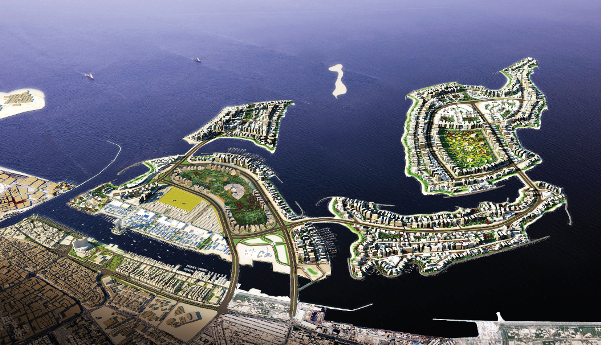
At long last, there seems to be some action from Nakheel’s Deira Islands with 94 of 500 plots, ranging from 50k sq ft to 670k sq ft, being released in phase 1. To be located on two of the four main islands, it will be mainly for hotel and resort projects. When completed, this development will have 23k hotel rooms and 31k apartments.

Dubai-based Habtoor Leighton Group, in a JV with Al Jaber Engineering, secured a major US$ 1.7 billion contract in Qatar. The project covers the design and construction of 56 km of the country’s New Orbital Highway and Truck Route, including five main interchanges.

Dubai’s Wasl Properties have completed a three-tower development in Deira, two of which house 217 apartments and the third being a 210-room 4 star hotel.

February was another bumper month for Dubai International with impressive growth in both passenger traffic and cargo. Compared to the same month in 2013, numbers were up 11.7% to almost 5.7 million and freight by 3.4% to 188.7k tonnes.

The troubled Gulf Navigation suffered another blow when it was forced to restate its 2013 results, after it had lost an arbitration case. Having already announced a US$ 190 million loss, it had to add a further US$ 62 million to its bottom line to report a loss of US$ 252 million.

Bahraini asset leasing company, Hanco, has paid US$ 164 million to buy Byrne Investments Limited, including Byrne Equipment Rental and Spacemaker. The long-established Dubai company, formed by Seamus Byrne, is the region’s largest rental company, employing 450 staff.

As part of its cash flow strategy, Dubai International Capital, part of Dubai Holding, is reportedly divesting itself of one of its major assets to raise funds to help with its debt repayment programme. It seems that of the four potential suitors, Clayton, Dubilier & Rice, a private equity firm, is favoured to purchase German-based packaging group Mauser for around US$ 1.5 billion.

Meanwhile, another arm of Dubai Holding, Tecom added another 233 companies in 2013 to bring the total number to over 2,000. It is estimated that an additional 622k sq ft of space was brought on line in Dubai Media City, Studio City and International Media Production Zone, to cope with this expansion.

Ithmar Capital, founded in 2005, expects to expand its portfolio by up to 33% this year. Currently, the Dubai-based private equity firm manages investments of around US$ 800 million and expects new deals to originate mainly from the education and health-care sectors.

One sector of the Dubai travel industry, that is set to expand over the next three years, is medical tourism. Health bosses estimate that revenue generated from this segment could grow from US$ 178 million to US$ 300 million, as numbers increase from today’s 107k to 170k.

A recent study by MasterCard seems to indicate that the UAE has the largest percentage of online shoppers in the region. Some estimate that within five years this sector will generate more than US$ 10 billion with the likes of souq.com and Cobone leading the way. PayPal estimate GCC on-line sales to top US$ 15 billion in 2015 – a 66.7% surge from 2012’s US$ 9 billion.

Apparently with little else to do, the IMF has again flagged the region as prone to a boom / bust cycle. Reiterating its October 2013 report, it considers that the realty sector could become a bubble, if not managed properly, and suggested that regulators, including the Central Bank, take further steps to ameliorate any future problems.

In May, the UAE bourses will be upgraded by MSCI Inc, a US-based provider of equity, fixed income and hedge fund indices. This important reclassification sees the country being moved from Frontier Markets status to Emerging Markets and could result in more than US$ 1 billion being invested locally. The significance of this upgrade is that international investors will be able to trade directly in the local markets.

Next month, Emirates Reit is going public on Nasdaq Dubai with an issue price of between US$ 1.36 and US$ 1.56, valuing the company at between US$ 356 million and US$ 408 million. The Dubai-based real estate investment trust is partly owned by Dubai Islamic Bank (30.9%) and Dubai Holding (27.1%).

Nearly six years after having its shares suspended on the DFM, Amlak is hoping to start trading again later in the year. The outlook for Dubai’s real estate sector is a lot rosier now than it was in November 2008 when villa prices tanked, by as much as 60%, whilst available credit was just an illusion

After a massive 8.2% surge last week, the bourse rose by 1.7% from its Sunday opening of 4306 points to close on Thursday at 4381. Bellwether stocks, Emaar and Arabtec, were trading at US$ 2.68 and US$ 1.62 respectively. The market is already 31.87% up this year.

China’s shadow banking segment is still a major problem for the economy as it continues to expand because of the tight regulations, high interest rates and lending restrictions in the official banking sector. In January, a wealth management fund nearly defaulted which did little to foster consumer confidence. A banking crisis is imminent and collateral damage across the globe is inevitable.

The Crimean squabble between Russia and the West will have a negative effect especially on the European economies. As the political stalemate continues, both sides have upped the rhetoric and imposed sanctions with no apparent appeasement on the agenda. Furthermore the UN Security Council has little or no influence since Russia has the right of veto. The World Bank has estimated that the Russian economy could shrink by 1.8% this year if there is the impasse continues. The cost to the eurozone could be infinitely higher.

With World Earth Day occurring this Saturday, Dubai is using an increasing amount of both electricity and water. The former used saw a 3.3% annual increase to 6,857 MW whilst there was a 3.85% jump in average daily water usage to 296 million gallons. DEWA announced that it will spend US$ 5.45 billion over the next six years on three major projects to ensure that future demand will be met. One of these will be a clean coal plant, costing US$ 3.54 billion with a 1,200 MW capacity.

Coinciding with World Earth Day is the Dubai World Cup, the world’s richest horse race. With 70k spectators filling Meydan to the rafters, and millions watching on global TV, this event adds millions of dollars to the local economy as well as prize pool on the night of US$ 30 million to the winning connections. Watch out for a Dubai winner, either African Story or Mukhadram, or the Irish interloper, Ruler of the World. Whoever wins will be On Top Of The World!

Posted in Finance | Tagged , , , , , , , , , , , , | Leave a comment

Won’t Get Fooled Again

Mike_AshleyThis week, HH Sheikh Mohammed bin Rashid al Maktoum approved a US$ 136 million plan to build a 1.4 km bridge from JBR to the upcoming Bluewaters Island, with further access by footbridge and monorail.  The US$ 1.6 billion project, encompassing a five star hotel, residential units and retail and dining outlets, is to have the world’s largest Ferris wheel, surpassing that of Singapore’s 165 metres.

In yet another survey, this time by Knight Frank, Dubai is rated as having the best performing real estate in the world. Overall, 2013 prices were up 34.8%, compared to the global average of 8.4%. Their report also figures that prices are still 25% below the 2008 zenith but this has to be considered a little on the high side.

Good news for Emaar shareholders came with its Board proposing a 15% dividend as well as a 10% bonus share issue, to be discussed at April’s AGM. The company is also considering a dual listing of 25% of its retail division on Nasdaq Dubai and in London, at a price in the region of US$ 2.3 billion. It is also expected to carry out a similar exercise for its Egyptian operation. The market reacted favourably on Sunday with its shares on the DFM up 5.1% to US$ 2.48 on the day.The developer also launched the sale of its recently announced BLVD Crescent, including two towers – one 39 floors and the other 21 levels. It also awarded a US$ 354 million contract to Dutco Balfour Beatty to build the new Fashion Avenue extension in Dubai Mall.

There was plenty of other activity on the construction front. Nakheel awarded two contracts, totalling US$ 143.3 million, for construction of 401 residential units in its Al Furjan community, to be completed by the end of 2015. Deyaar managed to sell all 219 residential units in its 30-floor Atria project in one day, raising over US$ 136 million in receipts on its Business Bay development, to be completed by 2017.  A week after winning a US$ 208 million contract from Meraas for The Avenue Phase 2 City Walk, Al Futtaim Carillion has another order, for US$ 102 million from the Dubai World Trade Centre, for a 588-room hotel along with an eight-storey office building, slated for completion by mid-2015. Green Valley International Real Estate is planning to invest US$ 409 million in the country including an apartment building in Dubai Sports City. DIFC is set to launch a 128-room boutique hotel, costing US$ 68 million, near its Gate Village.

Arabtec’s Q4 profits rose a staggering 381% to US$ 33 million on revenue of US$ 627 million. So far this year, the company has increased its order book by US$ 49.0 billion! Based on a 2013 profit of US$ 103 million, the developer is expected to declare a dividend of US$ 0.002 per share plus bonus shares equivalent to 30% of its capital.

Dubai Industrial City announced a 67.1% jump in 2013 profits to US$ 56 million on a 33% hike in revenue. A further 158 new companies opened during the year – a sure sign that the industrial sector is becoming an increasingly important driver for Dubai’s burgeoning economy.

Dubai Silicon Oasis Authority increased 2013 profits by 23.5% to US$ 55.7 million. To help with making the DSO a truly global smart city, the government has earmarked US$ 654 million for further investment over the next three years.

Majid Al Futtaim will be spending US$ 204 million on its VOX Cinemas, including four new international locations – Bahrain, Egypt, Oman and Qatar. In Dubai, Shindagha and Burjuman will be new locations and there is to be a new 24-screen facility in MoE.

It appears that Thuraya Telecommunications wants to expand its operations into the US so as to increase its revenue stream. Last year, the Dubai-based company posted sales of US$ 122 million and is looking at double-digit growth over the next five years.

DP World recorded disappointing 2013 results even though there was a 10.8% rise in profits to US$ 604 million which included a US$ 158 million profit on sale of assets. But overall their profit, after including separately disclosed items, actually fell 13.3% to US$ 640 million on revenue of US$ 3.07 billion.

After two weeks of losses, the bourse returned to some sort of Dubai normality by jumping 8.2% from its Sunday opening of 3981 points to close on Thursday at 4306. Bellwether stocks, Emaar and Arabtec, were trading at US$ 2.36 and US$ 1.31 respectively – 17% and 12% up on the week.

Another new local listing this week on Nasdaq Dubai; the US$ 300 million Dubai Investments Park’s sukuk brought the number of new listings to the bourse to US$ 12.5 billion over the past fifteen months.

The Department of Economic Development is seriously looking at setting up an Islamic export/import bank to boost foreign investment and trade. The proposed financial institution would be the world’s first Shariah-compliant Exim bank.

As widely expected, the Central Bank has agreed to refinance Dubai’s US$ 20 billion debt facility for a further five years at 1% over EIBOR. Half of the debt was maturing this month with the balance due for repayment in November.

Official figures indicate that in February, Dubai inflation, at 2.6%, was at its highest level in over four years. With housing and utility costs accounting for 44% of expenses, many would have thought that this figure would be higher than the 4.5% recorded.

Property prices are also shooting up in Australia which has some of most expensive realty in the world. With it being estimated that the Chinese are pouring in US$ 4.5 billion every year, the Abbott government is considering ways to curtail overseas purchasers pushing up prices even further. Is there any chance of Dubai doing likewise?

It is no surprise that the Federal Reserve saw its 2013 net assets jump by  US$ 1.1 trillion, inflating its total assets to over US$ 4 trillion. Courtesy of QE, every month last year, the US government made asset purchases of US$ 85 billion. Consequently, the US Treasury’s coffers increased by US$ 79.6 billion – the Fed’s net profit for the year. On Wednesday, the QE program was further tapered by a further US$ 10 billion to US$ 55 billion.

This phasing out of quantitative easing is having a negative impact on emerging markets, including the “fragile five” – Brazil, India, Indonesia, South Africa and Turkey. The turning off of the tap of easy money will expose such economies to capital outflows and will add to their already inflated current accounts and external debt. As currencies weaken, servicing debts, in say dollars or euros, becomes more expensive and local interest rates move higher to attract investment. The problem is further exacerbated every time the Fed decides to reduce QE and when confidence goes, a liquidity crisis will be unfortunately followed by a fully blown financial crisis.

Is there any doubt that the rich are getting richer with the gap between rich and poor becoming larger by the year? It is inequitable to see that, in the UK, the five richest families – Grosvenors (US$ 13.1 billion), the Reuben brothers (US$ 11.5 billion), the Hinduja brothers (US$ 10.0 billion), the Cadogan family (US$ 6.6 billion) and Mike Ashley (US$ 5.5 billion) have more money than 12.6 million – or about 20% – of the country’s population.

Ominous signs are looming for the eurozone as it heads towards deflation with February inflation figures of 0.7% – well down on the ECB’s 2.0% target and its December 2011 return of over 3.0%. Despite the bank’s president, Mario Draghi, insisting otherwise, this is a problem that will not go away and will inevitably cause economic problems for the 18-nation bloc. Surely he Won’t Get Fooled Again!

Posted in Finance | Tagged , , , , , , , , , , , , , , , , | Leave a comment

How Bizarre

malaysia-airlinesBoeing seem to be having continuous problems with its new 787 Dreamliner – the latest being hairline cracks in the wings, manufactured by Mitsubishi. Another minor problem is that Emirates apparently have yet to sign off on their US$ 76 billion order for 150 777X aircraft. It seems that further negotiations have to take place, on items such as technical support, performance guarantees and warranties, before the final contract is signed.

Although better known for its electronics retail operations, Jumbo Group has ambitious plans for both its engineering and B2B divisions which they expect to become increasingly important parts of their future strategy. Not forgetting their core business, they are also looking at expanding in markets such as India, Iran and the GCC.

Staggering news from Arabtec was the awarding of a US$ 40.23 billion contract to build one million houses for the Egyptian army! Expected to be completed within six years, the development will spread across thirteen sites and cover an area of 160 million sq mt.

Damac Properties have been quick off the block announcing the launch of Celestia, which will be located at the EXPO 2020 site. The development will comprise eight floors of luxury serviced hotel apartments with the usual amenities such as restaurants, retail outlets and a health club.

Dubai Silicon Oasis announced a US$ 300 million smart city project, comprising 100k sq mt, which will have areas for commercial, residential, a 115-room business hotel, retail and restaurants. The unique feature of this development is that it will be only serviced by electric cars.

Following a favourable response to its first sale of units in Mulberry at Park Heights, Emaar is going ahead with a further one for 330 apartments in its Dubai Hills Estate. Located in the new Mohammed bin Rashid City, this huge development is a JV with Meraas Holding. The sale will take place this week on-line and in various locations – Dubai, Abu Dhabi, Baku and Hong Kong.

Al Futtaim Carillion is set to build The Avenue Phase 2 City Walk, having been awarded the US$ 208 million contract by Meraas. Phase 1 was finished last year whilst this stage – including entertainment and retail – is set to complete by mid-2015.

Since the June 2013 launch of its Dubai Design District, TECOM has received more than 500 enquiries from entities wanting a presence in this new area. Some licence applications are well under way despite the first phase, of what is known as d3, not being ready for another year. Located adjacent to Dubai Mall, the total project cost is estimated at US$ 1 billion.

Two GCC companies are planning to invest in Dubai. This week, Saudi’s Al Hokair Group opened its eighth Sparky’s leisure centre, at a cost of US$ 8.2 million, and will invest a further US$ 41 million in the country over the next two years. Kuwait’s IFA Hotels and Resorts is going to build an eight-storey mixed use development, including 300 units. The project, known as The 8, is estimated to cost US$ 272 million and will be located on Palm Jumeirah and should be finished by 2016.

The RTA is going ahead with enhancing the road infrastructure in Barsha. The US$ 27.2 million contract is part of the US$ 272 million Phase II of the 2012-2016 road network plans. It is estimated that the RTA has been responsible for the construction of over 500 km of roads since 2011.

Further to the issue last May of a US$ 500 million bond, Commercial Bank of Dubai has obtained shareholders’ approval for a US$ 2 billion bond. Last year, the funds raised were used for general corporate purposes but there is no information on CBD’s latest foray into the bond market.

Turnover has almost halved on some days to around US$ 170 million as investors turn their back on the DFM. After sixteen weeks of continuous growth, the bourse disappointed for a second straight week falling 4.2% from its Sunday opening of 4154 points to close on Thursday at 3981. Bellwether stocks, Emaar and Arabtec, were trading at US$ 2.36 and US$ 1.31 respectively.

The emirate’s 2013 non-oil trade witnessed a 7.1% rise to US$ 359.7 billion, reflecting the current boom in Dubai’s economy. India, China and US were the top three in total trade at US$ 37.3 billion, 36.8 billion and 23.4 billion respectively. Imports were up 10.0% to US$ 221 billion whilst exports and reexports rose by 4.0% to US$ 14.1 billion.

Acting on behalf of 38 failed banks, , the US Federal Deposit Insurance Corporation is suing sixteen major financial institutions, including Bank of America, JP Morgan Chase, HSBC and Barclays,  for allegedly manipulating Libor. The sums involved are massive and estimated to be above US$ 300 trillion with the banks facing possible penalties of up to US$ 40 billion.

A further Chinese slowdown is almost inevitable following the February trade figures as exports dropped 18.1% year on year, imports rose 10.1% and the trade balance fell into negative territory, from a January surplus of US$ 32.0 billion to a deficit of US$ 23.0 billion. One slither of good news was the fact that China has overtaken the US as the in relation to the trading of physical goods which totalled US$ 4.16 trillion last year.

Japanese economic data is more than disappointing as weak numbers continue such as a marginal Q4 growth of 0.2% and a huge 30.3% annual surge in imports. This may be a good indicator that Abenomics is not working for the world’s third biggest economy. However, with a sales tax increase from 5% to 8% due in April, consumer spending has rocketed.

The ‘Is’ have it! A quick look at four countries – Ireland, Italy, India and Indonesia – will demonstrate how precarious is the state of the global economy.

With several pharmaceutical patents expiring last year, there was a knock on effect on Ireland’s net exports, which fell 10.9%. The Gaelic economy sank 2.3% from Q3 to Q4, with the problem being further exacerbated by a 5.8% increase in imports  a brain drain of its young talent and a slight 1.1% fall in personal consumption. A 0.3% contraction in 2013 GDP shows that the country is still technically in recession.

The fact that the Italian economy in 2013 is smaller than it was in 2000 is an indicator on the massive challenges facing the new prime minister, Matteo Renzi. A few of the problems facing Europe’s third biggest economy include a government debt equivalent to 130% of GDP, unemployment at 12.7%, youth unemployment at 56%, a 2013 contraction of 1.3% and a record number of businesses going bankrupt or closing. No wonder even the EU has downgraded its outlook for the economy. Just to add to Italian woes, UniCredit, the country’s biggest bank, has just announced a record 2013 loss of over US$ 19 billion, most of which is attributable to the write off of bad loans.

Indian growth forecast has been further reduced to 4.5% this year – down from the government’s estimate of 4.9%. As the RBI is keen to maintain rates high for the immediate future – with the aim of keeping a lid on inflation – some sectors, such as manufacturing and agriculture, will continue posting disappointing returns.

Latest data from Indonesia show a January trade balance deficit of US$ 430 million. An appreciating rupiah, up over 7% this year, and inflation at 7.75%, do little to help the country’s competitiveness. Furthermore global uncertainty may result in capital outflows from Jakarta which will have a further damaging impact.

Whilst on the letter ‘I’, it is inevitable that interest rates will start rising earlier than many expect. That being the case, those who have overextended and taken on too much debt could find themselves in financial trouble. This applies to governments, companies and individuals.

A week after its disappearance from the skies, the whereabouts of the Boeing 777 of Malaysian Airlines is still unknown. It does seem strange that, in this day and age, such a big aircraft can disappear from sight without anyone knowing what has happened. Just like American Airlines flight 77, a Boeing 757, which crashed into the Pentagon, the aircraft manufacturer is involved in another mystery. How Bizarre!

Posted in Finance | Tagged , , , , , , , , , , , , , , | Leave a comment

Back In The USSR

putinKnight Frank’s 2014 Wealth Report shows that Dubai had the seventh biggest annual increase in the global prime luxury market. At 17.0%, it was a lot lower than the likes of the top three – Jakarta, Auckland and Bali at 37.7%, 28.8% and 22.0%. It was also classified as the 19th most expensive city for such property. Surprisingly, the report showed that a US$ 1 million outlay would purchase 146 sq mt in Dubai compared to 15 sq mt in Monaco, 20.6 sq mt in Hong Kong and 25.2 sq mt in London.

Yet another survey points to the fact that all is well on the realty front and that a bubble is unlikely. This time, Citigroup indicated that Dubai can absorb the extra annual supply of 25k properties coming  to the market although other reports have concluded that the number of new builds will be greater.

Dubai developer Damac saw its 2013 profits more than triple to US$ 642 million as revenue rose 77% to US$ 1.2 billion. With booked sales having almost quadrupled, from US$ 661 million to US$ 2.5 billion, no wonder the shareholders, who bought at the developer’s LSE December IPO, are smiling. It is expected that the company will deliver more than 5,000 units to the Dubai market in 2014.

Diamond Developers announced that the first phase – being 100 town houses – of Dubai Sustainable City will be completed by the end of this year. The US$ 300 million development, which will include 500 units, a school, community centre and a country club, will be finished by 2015. Located in Dubailand, it will also have 20k trees, a canal and a 600k sq ft solar park.

Emaar have awarded a US$ 283 million contract to Arabtec for the construction of 1,500 townhouses. The project is due for completion by Q1 2016.

Following the February Sharjah launch of the first My Community Centre, retail conglomerate, Majid Al Futtaim, has announced a similar project in the International Media Production Zone. The initial phase of the proposed 1 million sq ft shopping mall will be completed by the end of 2015. This could be the first of up to 20 such malls, to be opened by the company in Dubai over the coming years.

Last year, hotel guests in Dubai rose 10.6% to 11.0 million – a sure indicator that the emirate’s tourism sector is in rude health. The impact of the Emirates / Qantas tie up can be seen from the number of Australian guests rising 39.4% to 269k. Almost I in 8 of visitors emanated from Saudi Arabia which had a 19.9% increase to 1.35 million. Total hotel revenue was up 16.1% to US$ 5.95 billion whilst total guest nights increased from 37.5 million to 41.6 million over the year. The number of available rooms increased by 5.1% to 84.5k whilst establishments rose  2.0% to 611. Over the next three years, a further 141 hotels / hotel apartments, with 29.5k rooms, will come on stream.

With the opening of its second tower this week, the world tallest hotel, JW Marriott Marquis Hotel expanded its inventory from 804 to 1,098 rooms. By September, this will increase by a further 510.

A new entrant is expected to move into the burgeoning hospitality sector. Deyaar Developments is planning several hotel and serviced apartment projects and have reportedly allocated 1 million sq ft in Business Bay and around the 2020 Expo site for construction. The Dubai-based company currently has a portfolio of 20,400 units which generates rental earnings of US$ 177 million.

Already owning four properties in Dubai, including Carlton Tower Hotel and Four Points Sheraton, First Investor is looking at bringing in a new budget brand to the Dubai market, as well as building a new hotel on SZR.

In the wake of the success of its first auction, Nakheel will shortly hold another one for residential plots from the same locale – Jumeirah Park. It raised US$ 9.3 million last month on eight plots.

The RTA is to spend US$ 27 million on the 14km Jumeirah Corniche project which will comprise a five meter walking path, a four metre wide jogging track and rest areas. The development will spread over six beach communities.

Following acceptance, by 91% of shareholders, of a US$ 88 million offer by the Al Futtaim Group, it seems that a Kenyan car retailer will soon be a Dubai-based company. CMC Holdings is that country’s distributor for Ford, Volkswagen and Suzuki.

With 2013 revenue topping US$ 1 billion for the first time in its short 4-year history, flydubai recorded another stellar year reporting a 47% leap in profit to US$ 60.7 million. Passenger traffic surged 38% to 6.8 million, helped by the arrival of seven new aircraft, seventeen new routes and the introduction of a business class cabin during the year. At last November’s Dubai air show, the carrier ordered 75 Boeing 737 MAX 8s and 11 737-800s to add to its existing fleet of 43 aircraft.

Last month, the new Dubai Tram project started pre operation trials. Phase 1, which has cost US$ 1.09 billion and covers 10.6 km, will be finished by November whilst the tenders for phase 2 will not take place until late 2015. Covering a further 5 km, it will extend the track to the Burj Al Arab and MoE. The third phase will see the tramway reach all the way down to the end of Jumeirah Beach Road.

EFG Hermes have sold their 19% stake in Damas to Qatar’s Mannai Group which now owns 85% of the Dubai-based jeweller.

So as to refinance existing loans on more favourable terms, as well as for capex requirements, du has borrowed US$ 1.17 billion in three separate deals for US$ 720 million, US$ 300 million and US$ 150 million respectively. All three loans to the telecom provider are set at 140 basis points over the Libor rate.

The other provider, Etisalat disappointed the market even though Q4 were up 70% to US$ 395 million and this after taking provisions of US$ 278 million for losses in their operations in Indonesia and Nigeria.

As reported earlier, the Dubai Islamic Bank saw a 42.1% increase in 2013 profits to US$ 469 million. At this week’s AGM, it was decided to declare a 25% cash dividend.

In February, Nakheel paid US$ 640 million which represented more than a third of a loan that was not due for repayment until September 2015. This week, it is reported that Dubai World has made outstanding payments to creditors, totalling US$ 285 million, as part of the requirements of its US$ 25 billion debt restructuring plan.

Having so far invested in excess of US$ 1 billion in India, DP World has just started work on its US$ 200 million Mumbai cargo terminal. The Dubai government-owned already operates  five container ports in the country.

Drake & Scull’s German subsidiary, Passavant-Roediger GmBH has expanded its Indian footprint – this time for two contracts relating to water and wastewater treatment, valued at US$ 13.6 million.

Coincidentally, Drake & Scull was the last company to join the Dubai Financial Market. Five years on, it seems that Marka is set to become the latest member, as well as UAE’s first listed retailer, with a US$ 136 million IPO. The company’s founders would buy 45% of the shares whilst the balance – 275 million shares – would be offered to the public at US$ 0.27 per share.

The Dubai General Market Index opened on Sunday at 4220 points and by Thursday close had fallen back 1.2% to 4154 – but still up 23.3% on its 01 January opening of 3370. Bellwether stocks, Emaar and Arabtec, were trading at US$ 2.47 and US$ 1.29 respectively.

It can only happen in Dubai – a smart city, powered by solar power, is being planned for Emirati residents. Due for completion by 2020, the city will be home to 160k and cover an area of 14k acres. It will be fully sustainable and will be self-sufficient in all its resource requirements, including energy and transport.

Last week, Qantas came in with a US$ 211 million H1 loss and announced plans to slash staff numbers by 5k, as part of a US$ 1.8 billion cost cutting exercise. This week, the airline was hit by further bad news when the Australian government rejected its request for a US$ 2.7 billion loan facility. However, it did agree to lift the airline’s foreign ownership restrictions which will  open the gate for foreign investment.

Now the Bank of England has been dragged into the currency rigging row – along with at least ten banks. There is little doubt that this fraudulent manipulation could become a major problem and prove bigger than the Libor scandal which cost banks, including Barclays and RBS, more than US$ 6 billion in fines.

Shanghai Chaori  has reportedly defaulted on a US$ 15 million interest payment relating to a US$ 1 billion loan The solar panel maker becomes the first Chinese entity to renege on an onshore bond – and this could be a precursor of more of the same. Traditionally, the Chinese government has always manged to “save” defaulting companies but now with such bonds totalling an estimated US$ 1.5 trillion, the Chinese government has indicted that some firms will have to go under.

There is no doubt that Vladamir Putin is playing hardball over the Ukraine crisis. With an economy that is in steady decline, a fall in consumer confidence, a sinking stock market and a currency that is going down the toilet, the Russian leader has done something drastic. He is gambling that the G7 will not impose economic sanctions for his escapade into the Crimea, where Russia has a lease until 2042 on the major Crimean port of Sevastopol.

HE Sultan bin Saeed Al Mansouri, Minister of Economy, confirmed that the UAE economy is now valued at US$ 381.5 billion, having grown by over 4% in 2013. Although the figures are impressive, he did make the point that they would have been better if the US and European economies had performed better. One thing certain is that the whole global economy – including that of Dubai – will suffer if the Ukranian problem is not sorted quickly and Putin sends his troops Back In The USSR.

Posted in Finance | Tagged , , , , , , , , , , , , , , , , , , , , , , , | 1 Comment

The Show Must Go On

MugabeOn Sunday, Nakheel paid off more than a third of a loan that was not due for repayment until September 2015. The US$ 640 million early settlement is an indicator that the developer has recovered from its enforced August 2011 restructure as a result of the mess left behind after the GFC. The company has also just raised US$ 9.3 million by auctioning eight plots in its Jumeirah Park project.

First launched some eight years ago, before the GFC, Schion Properties finally expects to complete the Dubai Lagoon project by 2016. The first of seven zones – which encompass some 5.7 million sq ft – is expected to be handed over by the end of this year.

Deyaar added a further 2,600 units to its inventory last year bringing its total to just under 20,400, with rental earnings of US$ 177 million. The developer expects to add a further 2,000 properties to its portfolio in 2014.

MAG Group is certainly embracing the current wave of optimism in the real estate sector, with plans for a City of Arabia residential development, worth US$ 236 million, and a US$ 191 million art centre in Barsha. This is in addition to the US$ 1.36 billion already invested, including its US$ 545 million Meydan project for both townhouses and low rise apartment buildings.

Not only is Dubai aiming to be a global Islamic financial centre but also a hub for halal food, personal care products and cosmetics with TECOM launching a dedicated Halal Cluster in Dubai Industrial City. The centre – spread over 6.8 million sq ft – will also be concerned with logistics.

The success of the Metro can be seen with passenger numbers almost doubling over the past two years to 138 million in 2013. Overall the RTA estimate that public transport – including the Metro, buses, taxis and water transport – carried 441 million passengers, 27.2% more than in 2012.

January was another record month for Dubai International with traffic up 15.1% to 6.4 million passengers, compared to a year earlier. Emirates’ alliance partner Qantas is not faring well and is expected to announce a US$ 235 million half year loss. Consequently, boss Alan Joyce has to cut costs by US$ 1.8 billion which may entail axing 5,000 jobs in the struggling airline.

It comes as no surprise to see that Emirates is once again the world’s leading airline brand, valued at US$ 5.48 billion; this amount was 34% higher than  2012 and pushed the airline from 287 to 234 in the global top 500 brands. The only other ranked UAE company was Etisalat at 432.

Emirates SkyCargo has commenced moving all its operations to the new Dubai World Central. As an interim measure, it has signed a five-year contract with Allied Transport to provide 45 trucks to ferry goods between the two facilities, as freight will still be coming into Dubai International, via passenger aircraft.

Rumours abound that Arabtec will probably acquire the Kuwaiti Kharafi Group, in a deal expected to be around the US$ 1 billion mark. This would be another piece in the jigsaw as the Dubai-based contractor aims to become the leading construction company in the region. Coincidentally Arabtec’s shares were suspended on Wednesday by the Securities and Commodities Authority, with no formal reason given.

The Dubai General Market Index opened the week at 4183 points and rose 1.0%, when closing on Thursday at 4220 and is already up 850 points, or 25.2%, on its January opening of 3370. Bellwether stocks, Emaar and Arabtec, were trading at US$ 2.48 and US$ 1.31 respectively.

The Dubai Gold and Commodities Exchange has launched yet a new futures contract – this time for polypropylene. Sized at five metric tons, and priced in US$, this is a first for the region.

Meanwhile the Dubai Multi Commodities Centre (DMCC) has refuted allegations that it acted improperly over the Kaloti Group’s apparent lack of transparency in its dealings with conflict gold trades. The company, the largest regional gold refiner, has been accused of paying more than US$ 5 billion in cash, without the requisite documentation, to several hundred customers.

With the lifting of EU sanctions on diamonds from Zimbabwe’s Marange field, there is every chance that some of the precious stones will soon be traded in Dubai. The authorities are seemingly satisfied that there is no forced labour or corrupt behaviour by the Zimbabwean mining chiefs.

Earlier in the month, Dubai rolled over a maturing US$ 10 billion loan from the Central Bank at more favourable rates. Whilst this will assuage concerns over payments of current liabilities, there is still a question mark over the timing, scale and financing of future mega projects. If this were carried out, without some sort of formal strategy, there is the inevitability of a bubble that would be bigger and more damaging than what occurred in 2009.

December bank lending rose 7.1% – its quickest rate since 2010 – reflecting increased consumer confidence in the buoyant Dubai market. Bank deposits, loans and advances and assets have all headed north rising by 0.4% to US$ 348.5 billion, 0.3% to US$ 320.8 billion and 1.7% to US$ 552.0 billion respectively.

The 81% UK government-backed RBS has announced a staggering 2013 loss of US$ 13.7 billion but, in true banking arrogance, will go ahead with bonuses amounting to US$ 960 million – and this after six straight years of losses!

Despite protestations by Brussels bureaucrats that all is well in the eurozone, nothing could be further from the truth.  Italy is still mired in a deep recession and not helped by the fact that Europe’s third biggest economy witnessed a record 2.1% fall in retail sales last year. With consumer confidence low, a large public debt, high unemployment and an increased tax burden, it would seem that 2014 will not be any better. Spain’s economy contracted a further 1.2% in 2013 and any sign of a recovery is at best patchy.

Q4 growth in US has been revised downwards by 25% to 2.4%, as consumer spending, which accounts for almost 70% of all economic activity, came in a lot less than forecast. As expected, new Federal Reserve chief, Janet Yellen, confirmed the continuance of existing stimulus measures which currently sees the Fed purchasing bonds at the rate of US$ 65 billion a month, with the aim of stimulating the economy.

A weak currency, a marked fall in foreign investment and high inflation have seen India’s growth rate drop to 4.7% in Q4. This is the fifth quarter in a row that Asia’s third biggest economy has had growth of under 5% – and it was only two years ago that 8%+ was the norm.

Corporate debt in China has hit record levels with some estimates as high as US$ 12 trillion – or 120% of the country’s GDP. If the current growth rate continues, then there is the inevitability of a  credit crisis which would spell global economic trouble. Stocks in Beijing fell during the week as did the yuan which saw its biggest drop in three years. There are some who see a link between the decline in the currency and the slowdown in the Chinese economy.

Globally, shares were at a six-year high but investors’ euphoria cannot continue indefinitely. In the US, the S&P 500 reached an intra day record whilst the Nasdaq hit levels not seen this century. In Japan, the Nikkei topped the 15,000 mark whilst Australia’s stock market continues its upward spiral. Unfortunately, a correction is long overdue: this will be sooner, rather than later, but nobody knows for how long The Show Must Go On!

Posted in Finance | Tagged , , , , , , , , , , , , , , , , | Leave a comment

Up, Up and Away

goldbarsEmaar released their 2013 results this week with a 21.3% jump in profits to US$ 698 million on a 25.2% rise in revenue to US$ 2.81 billion, of which its retail and hospitality sector accounted for 46%. The developer sold property at more than US$ 3.27 billion – three times higher than in the previous year.

Majid Al Futtaim will add another floor to its Mall of the Emirates, thereby upping its current retail space by a further 25k sq mt. This forms part of its scheduled US$ 273 million development plan for a 25% increase in retail space by the end of next year.

Nakheel has received six tenders – the cheapest of which comes in at US$ 323 million – for its US$ 681 million Nakheel Mall. Situated on Jumeirah Palm, and covering 418k sq mt, the complex, which will include 200 shops and twelve restaurants, should be completed by 2016, with the nominated contractor being announced within three months.

EFECO, a subsidiary of Arabtec Holding, has won a US$ 272 million contract for MEP work in Kazakhstan. This is part of a US$ 1.1 billion Aldar Abu Dhabi Plaza development in the capital Astana.

Emaar has signed a Memorandum of Understanding with Abdul Latif Jameel for future real estate projects in Saudi Arabia. The JV will be known as Emaar Jameel.

The company also released their 2013 results with a 21.3% jump in profits to US$ 698 million on a 25.2% rise in revenue to US$ 2.81 billion, of which its retail and hospitality sector accounted for 46%. The developer sold property at more than US$ 3.27 billion – three times higher than in the previous year.

Deyaar is set to increase the percentage of its shares that can be bought by foreign investors with a proviso that 51% must be in the hands of Emiratis; of the 49% balance, 24% must be held by GCC nationals. Other companies are looking at loosening the ownership restrictions before the local bourses join the MSCI Emerging Markets Index in May.

As reported earlier, Dubai hotels had a bumper 2013 with three major indicators all moving upwards: GOPPAR (gross operating profit per available room, ARR (average room rates) and RevPAR (revenue per available room) were up 10.3% (US$ 206), 6.5% (US$ 324) and 7.6%. Furthermore official figures also reflect the growth with Dubai International recording a 15.2% surge in passenger traffic to 66.4 million as well as hotels showing a 10% rise to 7.9 million for the first nine months of 2013, with spending up 17% at US$ 4.2 billion.

The Dubai-based district cooling company, Empower, is finalising a US$ 600 million six-year loan which is largely being used for its recent US$ 500 million acquisition of Palm Utilities, formerly part of Dubai World.

DEWA has started work on a 400kv main substation which will provide power to the massive US$ 8.2 billion Mohammed bin Rashid City. The unit, scheduled for completion in 2017, will provide electricity for the exciting development that will encompass 54 million sq ft.

Dubai Investments joins a host of developers who have recently announced major projects as the emirate’s real estate sector gains traction. The company will soon be relaunching its US$ 817 million Mirdiff Hills development along with phase 3 of its Green Community. The latter will have 250 units and will cost US$ 136 million.

The RTA has approved US$ 28 million funding for the construction of the Muhaisna 2 Internal Roads project. This is part of a US$ 271 million plan for the paving of internal roads in several residential communities. 

Despite a 9.7% hike in its 2013 revenues to US$ 2.94 billion, du’s profit, after royalties, remained flat at US$ 542 million. The Dubai-based telecom operator had to pay an additional US$ 50 million royalty fee in 2013, bringing this total annual payment to US$ 278 million.

Shuua Capital had an eventful 2013 and managed to turn a US$ 16.1 loss into a US$ 0.8 million profit – significant in that it is Dubai’s oldest investment bank’s first annual profit since the start of the GFC in 2008. Revenues were up by 44% to US$ 534 million.

A recent US study indicates that the country will double its spend on domestic security to over US$ 10 billion over the next decade. Security at the local airports is set to tighten even further with up to US$ 60 million being expended over the coming twelve months. 

Five years after borrowing US% $ 510 billion from the UAE Central Bank, Dubai has rolled over the debt on more favourable terms. Although the initial debt maturity is in March, the terms of the revised loan is unknown.

The Dubai General Market Index opened the week at 4099 points and rose 2.05% when closing on Thursday, to 4183 and is already up 24.1% on its January opening of 3370. Bellwether stocks, Emaar and Arabtec, were trading at US$ 2.44 and US$ 1.32 respectively. 

Gold has managed to break out of its recent moribund trading pattern and had reached the US$ 1,323 mark by the end of the week. However, there are some who think that there could be some sort of manipulation going on between the five banks – Bank of Nova Scotia, Barclays, Deutsche Bank, HSBC and Société Générale – who are known as the London gold fixers for a reason.

January saw US factory production fall 0.8% – its largest decline in almost five years. This was the latest indicator – following declines in employment and retail sales figures – that seems to indicate the fragility of US growth forecasts.

Along with the likes of a booming stock market, surging property prices, rising education fees and increasing living expenses, two other news items this week are sure fire indicators that the balloon is on its way up. Emaar go out and spend a reported several million dollars on a 150 million year old dinosaur for permanent display in its Dubai Mall. Meanwhile, Jumeirah Zabeel Saray have introduced the ultimate Friday brunch in what is the brunch capital of the world. Their Royale Brunch will have personal butlers serving the best of the best and priced at US$ 685. Hopefully the balloon has some way to go before It’s Up, Up and Away!

Posted in Finance | Tagged , , , , , , , , , , , , , , , , | Leave a comment

Do You Wanna Know A Secret?

Edward-SnowdenYou cannot keep Arabtec out of the news! The Dubai-based builder, with strong Abu Dhabi-backing, is planning to establish five new subsidiaries, four of which will concentrate on new infrastructure and utility projects within the region and further afield whilst the fifth, Arabtec Capital, will provide financial services.

Meanwhile a subsidiary of Arabtec, Emirates Falcon Electomechanical Company, was part of a JV that has just been awarded a US$ 240 million contract for MEP work at the new Abu Dhabi airport.

Passavant-Roediger, a German division of Drake & Scull, won three European contracts worth US$ 45 million: the three locations are in Bosnia, Romania and Turkey.

Following their La Pointe announcement last week, Nakheel reported initial work on three new projects, totalling US$ 11 million, in their Warsan Village and Al Furjan master communities.

The third online property sale, via e-Mart, has seen five commercial and residential properties go under the virtual hammer, raising US$ 51.8 million. Expect to see more of the same in months to come as this portal becomes more popular with end-users.

Yet another indicator of foreign interest in realty is that RP Group from India is planning to spend US$ 1.1 billion on four new projects in Dubai. These will include two hotels, a serviced apartment project and a 3 million sq ft development on SZR.

Dubai-based property group, Orion Holdings,  will start work on five new projects, valued at US$ 136 million this year, as it continues with its strategy of acquiring luxury properties in the emirate.

Dubai Investments estimates that it has US$ 2.3 billion tied up in local real estate and plans further projects in Mirdiff, Meydan and Jumeirah Village, in line with further strong growth forecasts for this sector.

Drake & Scull announced a 61% rise in 2013 profit to US$ 50.4 million, on a 47% jump in revenue to US$ 1.48 billion. At the end of the year, the Dubai contractor had an order backlog in excess of US$ 3.3 billion.

The French/Italian manufacturer, ATR, secured a near US$ 1 billion order from Dubai Aerospace Enterprise for twenty 72-600 turboprop aircraft. This, with an option for another twenty planes, will maintain DAE’s position as the region’s largest leasing company.

dnata – part of the Emirates Group – has paid US$ 74 million to Thomas Cook for its Gold Medal Travel Group, including Netflights.com and Pure Luxury which deals in luxury travel packages.

JAFZA reported a 273% upturn in 2013 profit to US$ 188 million on revenue of US$ 417 million. Despite an outstanding loan balance of US$ 705 million and a US$ 650 million sukuk, due for repayment in 2019, its balance sheet is looking stronger with investment property valued at US$ 1.67 billion.

The RTA has approved its 2014 budget which has expenditure of US$ 1.91 billion, of which 55.4% (or US$ 1.06 billion) is for new capital expenditure and the balance for operating costs. Although revenue is expected to climb 17% to US$ 1.36 billion, there will be a cash deficit this year.

There is no respite for the Dubai-based Gulf Navigation as it announced a near-fivefold increase in 2013 losses from US$ 40 million to US$ 190 million on a 32% fall in operating income to US$ 37 million.  It was no surprise to see the company’s assets fall by over 30% to US$ 417 million. It is estimated that nearly 90% of the loss was attributable to non-recurring expenses, including a goodwill write off and added provisions.

2013 once again saw the country as the US’s number one trading partner from the MENA region, as bilateral trade jumped 8.5% to US$ 26.9 billion. Exports were static at US$ 2.3 billion whilst imports rose by 9.1% to a record high of US$ 24.6 billion; as expected, transportation equipment accounted for 38.2%, or US$ 9.4 billion, of this total.

Despite 2013 load factors declining slightly by 0.1% to 77.3%, along with increasing capacity of 12.8% being greater than increased traffic of 12.1% (down from 2012’s 15.4%), Middle East airlines led the aviation world in growth. On a global scale, IATA reported that load factors were up 0.4% to 79.5% whilst demand and capacity were both up 5.2% and 4.8% respectively. The US and Europe had the slowest growth rates at 2.3% and 3.8%.

Non-UAE nationals were responsible for purchasing shares totalling US$ 1.05 billion in the first week of this month – this represented 38.3% of all shares bought. Total foreign ownership during this period amounted to US$ 7.8 billion.

The Dubai General Market Index opened the week at 3931 points and, just as last week, surged a further 4.3% to 4099 points, at Thursday’s close; YTD it is 21.6% up on its 01 January opening of 3370.

Toyota became the latest – and last – vehicle producer to pull the pin in Australia, resulting in a loss of 4k production jobs in Victoria. This comes after similar moves by Ford and GM and despite protestations by Prime Minister, Tony Abbott. Because of the recent high dollar and a regulated  labour market, costs escalated by so much that it was cheaper for production to take place in Indonesia, Thailand and even Japan. This could act as a wakeup call for the Lucky Country that was cushioned from much of the blow out from the 2008 GFC.

Most people associate quantitative easing with the US but it was Japan which first introduced this unconventional monetary policy back in 2001. The aim is to stimulate a country’s economy by purchasing banks’ financial assets which by increasing its monetary base will lower their yield return. But what is basically a money-printing exercise has seen Japan’s per capita QE spending at twice the US QE3 rate of that introduced by Ben Bernanke. Now the country is in the throes of economic turmoil. Hopefully the US economy, which has spent US$ 1.3 trillion on QE3 alone, since its September 2012 introduction, will not slide down the same slippery slope.

Just when banks thought 2014 could not be worse than last year, consider the following:

· The taxpayer-payer bank Lloyds is trying to push through increased incentive payments in the region of US$ 650 million or 11% higher than the previous year.

· Barclays, with 2013 profits down 33% to US$ 8.5 million and planning to cut staff numbers by 12,000, want a 10% increase in bonus payments to US$ 3.9 billion.

· JP Morgan Chase had their November US$ 13 billion fraud settlement (for selling bonds backed by dubious mortgages) blocked pending further judicial review and could find that they will have to shell out even more money. The bank is also involved in paying out over US$ 1.6 billion relating to their shady dealings with the Bernie Madoff Ponzi scheme.

· The probe by Danish prosecutors into bond price manipulation may expand beyond the lender and six of its employees.

Scarcely a week goes by without some high profile corruption news and this week is no exception with Mathew Martome, a former manager of SAC Capital, being found guilty of a securities fraud that made the company US$ 275 million. The company had already paid US$ 1.8 billion in fines last year but to date its founder, Steven Cohen, has not been charged in what has been described by New York prosecutors as the most lucrative trading scheme in history.

Political figures continue to have their nose in the trough. The former Italian Prime Minister, Silvio Berlusconi, is again in court – this time for allegedly paying US$ 4.1 million to a senator to help destabilise the then government. Ray Nagin, ex-mayor of New Orleans, has been found guilty of corruption by accepting bribes for his favoured treatment to contractors following Hurricane Katrina. Tommy Suharto, son of the former Indonesian president, has been implicated in a scandal involving Rolls Royce; he allegedly received US$ 20 million and a blue Rolls Royce for favouring RR Trent 700 engines for the national airline, Garuda. (This could be part of the reason why shares in the UK engine maker lost 13.6%, or US$ 6.4 billion, on Wednesday).

Some sources indicate that corruption is widespread in Spanish business and public anger has boiled over with a case involving the husband of the younger daughter of King Juan Carlos, Princess Cristina. Inaki Urdangarin has been accused of using his royal connections and of embezzling US$ 8.2 million of public money.

A recent EU report has again highlighted the scale of corruption among the 28-country bloc and has put a figure of at least US$ 164 billion. What the Brussels technocrats are going to do about it remains to be seen but it is hoped that they put their own house in order first.

India is awash with corruption. Over recent years, high profile cases include:

· SP Tyagi, former head of the Indian Air Force and his shady role in the purchase of Italian helicopters

· the 2010 New Delhi Commonwealth Games mired by corruption and inefficiency

· Ashok Chavan and his part in selling war veterans’ Mumbai apartments to cronies

· bribery claims relating to a recent US / Indian nuclear pact

· the telecommunication licences sold  to favoured companies at below market rates and estimated to have cost the government coffers US$ 37 billion

· the granting of lucrative coal deals, without any bidding, could have lost government revenue of an estimated US$ 35 billion

This week, it is reported from Oslo that whistleblower, Edward Snowden, could be a potential winner of the Nobel Peace prize. It is said that less than 1% of his files have been released and that some of the information therein is explosive. It can only be hoped that the true links between the trinity of governments, big business and banks can be exposed and that corruption is brought to centre stage. And in these circumstances, Do You Wanna Know A Secret? Yes.

Posted in Finance | Tagged , , , , , , , , , , , , , , , , | Leave a comment

Here We Go Again!

Shanghai-SkylineThe big news story of the week came from Arabtec as it announced that the Abu Dhabi state fund Aabar (a 22% shareholder in the Dubai-based builder) had awarded the company a massive US$ 6.1 billion contract for 28 buildings in the capital and nine in Dubai. Three of the six hotels will be located in Business Bay, with the other three, plus three serviced apartments, being in nearby Al Jaddaf. Aabar plans to spend an additional US$ 13.9 billion on construction and all work will be routed through Arabtec. Even before this news, their shares had almost doubled over the past six months and a further 12% jump this week saw the stock reach US$ 1.37.

The Al Fahim Group received a US$ 1.85 billion boost with the Hong Kong-based Chow Tai Fook buying into the Dubai Pearl project. The estimated US$ 6 billion project, financed by a consortium headed by AFG, will include seven hotels, 1,490 serviced apartments, a theatre and over 60 restaurants. On completion, it will be home to 9k and a workplace for a further 12k.

As part of a US$ 273 million redevelopment of Majid Al Futtaim’s Mall of the Emirates, Drake & Scull International have been awarded a US$ 30 million MEP contract. DSI’s shares hit a record high (US$ 0.47) on Wednesday as it revealed that it had also won a US$ 88 million contract for a project for King Saud University in Riyadh. More good news for the company came with Nakheel awarding a US$ 102 million contract to its subsidiary, Gulf Technical Construction Company, to build The Pointe on Palm Jumeirah.

Dubai-based MAG Group and Dubai Healthcare City have signed a US$ 218 million JV to develop a 1 million sq ft project that will include two hospitals, a clinic, a hotel and apartments. It should be completed within two years.

Asteco has reported that average sales in prime residential areas surged by more than 60% last year – with rental increases following roughly in tandem. By far the largest upsurge came in Q4 which witnessed a 23% price rise in villas and apartments. The feel good factor has had a positive impact but it seems that different studies come out with different figures, with the only point of agreement being that property prices are going up. By how much, nobody really knows.

There has been a strong recovery in the commercial real estate sector. The Royal Institute of Chartered Surveyors has indicated that the UAE and Japanese markets are leading the way in this recovery with the UAE’s Occupier Sentiment Index at 46 – its highest level for six years. RICS indicate that commercial rents will rise as demand continues to be greater than supply available.

In December, the hospitality sector continued to improve its profitability levels. Despite a 4.5% drop in occupancy rates to 79.5%, all other indicator headed north – ARR (average room rate), RevPar (revenue per available room) and GOPPAR (gross operating profit per available room) by 9.1% to US$ 368.22, 3.2% to US$ 292.70 and 3.9% to US$ 260.00 respectively. The annual figures also rose by 6.5%, 7.6% and 10.3%.

There was a 13% upturn in the number of visitors to Burj Khalifa in 2013, with the 1.87 million total split evenly between overseas and domestic traffic. Surprisingly, German tourists accounted for 23% of all overseas visitors followed by UK (15%), Russia (11%) and India (11%).

It is reported that a “Tourism Dirham” charge will be levied on all hotel rooms as from 01 April 2014. The levy will vary between US$ 1.90 to US$ 5.45 per room per night and the monies raised will go towards Dubai’s international marketing budget.

wasl hospitality has added to its Dubai portfolio of seven hotels (three under the Hyatt flag and four under Starwood management) by announcing that Hilton Worldwide will introduce its midscale brand, Hilton Garden Inn, to the emirate. Both hotels, totalling 365 rooms, are slated for a 2015 completion.

It has long been reported that services at Dubai International will be curtailed between 01 May and 20 July because of scheduled runway repairs and maintenance. It now seems that 25% of flights could be affected and this will necessitate either cancellations or moving flights to the newly opened Al Maktoum International during the 80-day hiatus. To date, only flydubai, Royal Brunei and FedEx have confirmed that they will move selected flights.

There will be plenty of capacity at the new facility. Since its October opening for passenger traffic, there have only been 65k passengers, whilst 2013 air freight figures showed a slight decline to 209k tonnes.

The RTA has announced that the Dubai Metro will be extended. The Green Line will see a doubling of its track to 41 km, with a further 11 stations, bringing its total to 31. The original Red Line will be extended at either end of the track with an additional 10 stations. (Rail journey numbers continue to rise with 330 million recorded in 2013).

Deyaar reported a massive hike in 2013 profits from US$ 10.5 million to US$ 42.1 million. Almost 44% of the profit (US$ 18.4 million) for the Dubai developer was attributable to Q4 trading – a sign of increased positivity in the real estate sector.

Aramex reported a 16% increase in its profit to US$ 20.8 million. There is no doubt that the Dubai-based logistics company will be spending big on regional acquisitions in the coming year.

Having had its problems following the GFC, Union Properties seem to have put all troubles behind them when announcing an almost nine-fold  2013 profit increase from US$ 48 million to US$ 430 million.

It seems increasingly likely that the Dubai and Abu Dhabi stock exchanges will merge in the not too distant future. It is reported that due diligence has already been carried out and that the deal just needs rubber stamping by the two emirates’ governments.

The Dubai General Market Index opened the week at 3770 points and once again defied gravity by jumping 4.3% to 3931 points, when closing on Thursday; YTD it is 16.7% up on its 01 January opening of 3370. Bellwether stock, Emaar received a boost with its credit rating raised to investment grade by Standard and Poor’s and was trading at a 65 month high of US$ 2.29 – still some way off its 2005 peak of US$ 7.50 but well above its 2009 nadir of US$ 0.46.

Although still concerned about a potential property bubble, the IMF has again upgraded UAE’s 2014 growth prospect to 4.5% – well up on their last announcement in October when the rate was 4.0%. The main driver in growth would be the launch of numerous mega projects ahead of the 2020 Expo, with a limited increase expected from oil because of the increasing global supply available. It also noted that Dubai’s GREs (government related enterprises) have debts of US$ 78 billion maturing over the next four years, including US$ 20 billion to its neighbour, Abu Dhabi.

The manufacturing slowdown in China was confirmed with a decline in the monthly PMI which dropped yet again in January to 50.5. The main reasons for this fall have been put down to a decrease in domestic consumption and a reduction in export orders. A much bigger problem faces the world’s second largest economy – its US$ 24 trillion credit system is spiralling out of control with much of it wasted through corruption and unnecessary mega projects. It can only be a matter of time before the fan is hit.

Deflation fears indicate that the eurozone countries are becoming increasingly reluctant to spend money as evidenced by abysmal retail sales figures in December – down 1.6% on November and 1% compared to December 2012. Worryingly, Germany saw a 2.4% slump compared to a year earlier.

But despite this, the ECB head, Mario Draghi, still maintains that deflation is not a threat to the 17-member bloc even as the January inflation rate slowed to 0.7%, compared to 0.8% in December.  The bank kept its benchmark interest rate at 0.25%.

Some disappointing economic news greeted the new Fed Chief, Janet Yellen. For the second month in a row, weak job numbers are a cause for some concern and a potential pointer that the recovery may be running out of steam. The 113k January figure was well down on expectations. This was allied with unexpectedly weak manufacturing data – another possible indicator that the recovery is not as strong as it was three months ago.

According to Jack Lew, Treasury Secretary, the US economy may see a further default by the end of the month if the US$ 16.7 trillion debt ceiling is not raised. Despite being in receipt of US$ 7 billion daily, it would only be a matter of time before the world’s largest economy falls into bitter bipartisan infighting that will eventually impact the global stage. Unfortunately, Here We Go Again!

Posted in Finance | Tagged , , , , , , , , , , , , , , , , , , , | Leave a comment