The Circle Game

magic-roundaboutThe following article was written over nine years ago and serves to show the cyclical nature of Dubai’s economy.

Looking beyond short-term gains

By Tim Howe, Special to Gulf News
Published: 12:00 April 17, 2005

There is no doubt that greed and ignorance continue to be factors that will affect the fortunes of Gulf-based investors. A check on various segments within the local economy bears witness to what can best be described as a feeding frenzy.

Just look at the price of freehold property and rentals. Again it would appear that landlords are really skimming the cream so that their short-term gains may result in long-term losses and not only for themselves. Dubai will lose its competitive edge if rentals and other associated costs continue to escalate at current levels.

In the global market place, business tends to gravitate to where costs are lower and if Dubai’s employment rates continue to climb upwards then some international business organisations may consider pastures new.

Even developers are jumping on the bandwagon whether it be delivering to customers a finished product that may be inferior / smaller than what had been promised or excessive hikes in service / maintenance charges. This sort of behaviour may prove beneficial at a micro level but could have a negative impact on the macro economic development in the longer term.

Too many people are investing in the real estate market, solely to speculate. This leads to a skewing in the balance of buyer occupier / buyer speculator ratio followed by the inevitable bubble. Economic history is strewn with examples of what happens when a bubble bursts. Everybody wants to double their investment even before the ink has dried on the sales contract and obviously there is no way that this can continue ad infinitum.

Gulf stock market investors seem to have forgotten what happened to the dotcom market barely five years ago. Some fortunes were made then but a lot more were lost mainly through the twin forces of investor greed and ignorance.

Further, hoteliers are raking in extraordinary revenue, what with their rates, occupancy levels and returns that could only be imagined some two years ago. The end result is that there is a chance that Dubai will price itself out of the global tourism market. If the visitor considers Dubai an expensive place then there are always alternatives elsewhere.

Not to be outdone, the educational institutions are also jumping on the bandwagon with school fees continuing to escalate at an alarming rate.

Recent weeks have seen the reporting season for both petroleum-related companies and banks. Some would consider that in many cases profits reported have been obscenely high. It does not take a Rhodes scholar to work out who ultimately pays – the customer.

Economists may argue that these are typical textbook cases of the Law of Supply and Demand in action. As demand rises in the short-term, prices will do likewise until the increased demand is satisfied by an increase in supply with the market returning to equilibrium. By this time, however, the damage to the economy may have already taken place.

It is about time that all consider the impact that greed will have on the local economy. The quest for a quick dirham now will inevitably harm the longer term future of Dubai. The storm clouds are beginning to appear and all involved should be aware of the possible consequences of becoming too greedy.

The only differences between 2005 and 2014 can be seen form the following table:

19 June 2005

19 June 2014

DFM General Index

5987

4593

Arabtec

US$

0.43

1.19

Emaar Properties

US$

8.95

2.51

Gold

US$

437.50

1,315.50

Oil

US$

59.18

110.26

Otherwise Dubai illustrates so well what Joni Mitchell meant when she sang that you go round and round and round in the Circle Game.

Posted in Finance | Tagged , , , , , , , , , , , | Leave a comment

Baby – What A Big Surprise

sepp-blatterThe 80-day on-going maintenance work at Dubai International has cut the facility’s capacity by 20% and, as a result, London Heathrow will maintain its number one position as the world’s busiest airport in 2014. But by this time next year, Dubai will take over that slot according to the Centre for Asia Pacific Aviation. In Q1, Dubai traffic, at 18.4 million passengers, was 14.75% greater than its European rival and its growth of 11.4% was also so much better than the 0.5% of LHR.

Emirates surprised the market, as well as Airbus, by cancelling their 2007 order for 70 A350 planes – a deal that seven years ago would have increased the plane maker’s revenue by US$ 16 billion and would be worth US$ 22 billion at today’s prices. The new model is scheduled to start commercial flights next year although Emirates was not going to bring them into service until 2019. Whatever the story, this is a major financial blow to two European companies – Airbus and Rolls Royce.

With new destinations – New Delhi, Kochi and Thiruvananthapuram – flydubai has doubled its presence in India which will prove a further boost for bilateral trade and tourism.

Q1 saw Dubai’s foreign trade at US$ 87.8 billion, with imports of US$ 54.9 billion, exports – US$ 7.2 billion and reexports – US$ 25.7 billion. China continued to be the emirate’s leading trading partner at US$ 10.5 billion – an impressive 27.1% rise compared to Q1 2013. Not surprisingly, India came in second, at US$ 7.2 billion, followed by US, Saudi Arabia and Switzerland. Trade with the EU jumped 18.4% to US$ 14.0 billion.

It is reported that the country’s economy grew by 5.2% last year, compared to 4.4% in 2012. It is expected that this year’s growth will be not much changed so long as the average oil price remains in the region of US$ 105 – US$ 110 per barrel and output at 2.8 million bpd. The economy grew at its fastest rate since 2007 as consumer confidence rockets, with leading economic drivers such as property, transport and trade growing 8.7%, 7.3% and 2.4% respectively. The IMF has estimated that the debt owed by the Dubai government and its related entities amounts to US$ 142 billion or 141% of its GDP.

As Dubai 2004 realty transactions reach in excess of US$ 27.5 billion, the Central Bank has expressed concern that the property market could be overheating, as rental yields drop below historic averages. House prices for the year ending 31 March 2014 registered a 27.7% surge according to a Knight Frank report, with rents increasing at a slightly higher rate. Although bank lending has increased by US$ 3.5 billion, or 12% over the year, their exposure – at US$ 78.2 billion – is considered manageable, representing less than 23% of total loans, whilst cash buyers still account for 70% of purchases. The main difference between the exaggerated growth prior to the GFC and now is that the former was driven by speculation, and a debt-inflated asset bubble, whilst today the main drivers are spectacular economic growth and a booming population.

The dairy industry is another economic success story with figures suggesting an annual growth rate of over 8%. The Dubai-based Al Rawabi is one of the three main regional players, along with Al Ain Dairy and Saudi’s Al Marai, who together account for 85% of the local market. Al Rawabi currently has 12k cows and is looking to adding a further 7k to the herd.

By the end of 2016, Dubai will have its own 2,000-seat opera house. Being built by Consolidated Contractors Company, it will be the centrepiece for the Opera District, located in Downtown, which will become the cultural centre for the emirate.

Plans for the Burj 2020 moved a step nearer with DMCC announcing that it had listed four companies to design what would be the world’s tallest commercial tower. The free zone is the largest in the country with 8,700+ companies and over 85k people living and working in its 66 tower blocks.

It appears likely that the first Mandarin Orient hotel in Dubai will be built by Wasl Properties and be located on Jumeirah Beach Road. With enabling work almost completed, tenders for the 235-room hotel will probably occur later in the year. The developer has already entered the hospitality sector with two Hyatt Palace hotels and serviced apartments and is currently building two Garden Hilton Inns in the emirate.

Nakheel has appointed Shangri-La Hotels and Resorts to manage the Palm Tower, located on Jumeirah Palm. The 52-level tower will have a 290-room hotel – occupying the first 18 levels – along with 504 furnished apartments with the highest 360 degree infinity pool in Dubai on the 50th floor. (Nakheel has also paid a profit payment of US$ 60 million on its trade creditor US$ 1.2 billion sukuk).

Damac Properties has rushed forward the sale of 500 units in its NAIA Hotel and Apartments to be located on the 1.3 km shopping strip in the Akoya development. Starting prices are US$ 185k with the company forecasting double digit returns for investors in the 28-storey building as they will be entitled to 40% of room revenue, with zero utility and service charges.

At last, there was some good news for Tanmiyat investors with the announcement that handover of Living Legends villas, in Dubailand, will commence by the end of the year. The US$ 1.9 billion Saudi-backed development has been beset by delays following its launch seven years ago. (Consequently, Tanmiyat has not appeared on this week’s Dubai Courts listing of 26 cancelled projects, involving 18 developers).

Schön Properties has reportedly tied up with Xanadu Real Estate Development and secured US$ 92.4 million to complete its long-delayed Dubai Lagoon project. The massive development, covering 5.7 million sq ft, was a victim of the GFC when many of its investors defaulted on payments. Now that confidence has returned to the market, the company has awarded a US$ 185 million contract to PGS Gulf Contracting to finish construction work within two years.

Only 18% of the 154 private schools in Dubai will not be raising their fees for the next scholastic year. The size of the increase is limited to a maximum of 3.48% for schools considered outstanding by the Knowledge and Human Development Authority (KHDA), 2.61% classed as good and 1.74% for those rated as either acceptable or unsatisfactory.

April saw a noticeable 3.5% increase in money supply aggregate M1 (banks’ current and call accounts) to US$ 116.2 billion whilst M0 (currency in circulation and at banks) fell marginally to US$ 17.8 billion, as did money supply aggregate M2 to US$ 306.2 billion. There were increases in both bank deposits – 1.0% to US$ 366.5 billion – and bank loans and advances – 0.6% to US$ 357.3 billion – whilst total bank assets dropped 0.2% to US$ 592.8 billion.

The DFM, opening on Sunday at 5101 points, had a turbulent week to close Thursday 5.2% down, or 265 points, to 4836. Although the market is 43.5% up on its 01 January opening of 3370, it is 10.0% down on its 2014 high of 5374 recorded on 06 May. Bellwether stocks, Emaar Properties and Arabtec, closed on US$ 2.68 and US$ 1.36 respectively.

The UAE continues to offer economic aid of almost US$ 5.0 billion to troubled Egypt and among the numerous projects is the construction of wheat silos that will help with cutting that country’s huge food import bill. On completion, the 25 silos, to be built by Arab Organisation for Industrialisation, an army-affiliated company, will be able to store 1.5 million tonnes of the grain.

Now the election process is over and Abdul Fattah Al Sissi has become the new president, Egypt can expect a continuation in negotiations with the IMF regarding a US$ 4.8 billion bailout package. This comes after discussions were curtailed last year following the ousting of the then leader Mohammad Mursi.

Not before time, the European Commission is set to examine the tax arrangements of Apple, Fiat and Starbucks in three member nations – Ireland, Luxemburg and Netherlands. The aims of the exercise are to ascertain whether the companies are breaching EU rules on state aid and whether they are paying their fair share of tax.

US expatriate residents will undoubtedly be aware of the US Foreign Account Tax Compliance Act which basically requires financial institutions to provide information, on request, relating to US citizens and companies. At least 70 countries – including the UAE – have signed up and for those that have not, the US Treasury has the power to levy a 30% withholding tax on payments made. To date, 77k banks have joined as Uncle Sam tries to hone in on money stacked away in overseas vaults by their citizens.

The patchy US recovery continues as latest jobs data indicate that unemployment levels have now dropped to 6.3%, as the country’s part-time workforce increases to 27.2 million. However, there has been a sizeable drop in the number of working-age with jobs down from 62.7% six years ago to 58.9%. 70% of the population is no better off, after adjusting for inflation, than they were at the turn of the century, with an estimated 30% lower and the next 40% unchanged. Consequently, since the GFC, median household income has fallen 6.4% to US$ 53k.

The World Bank has once again cut its 2014 growth forecast from its January estimate of 3.2% to 2.8%, citing various reasons including political unrest in the Ukraine, bad weather in the US and the Chinese slowdown. Furthermore, growth in developing countries was cut from 5.3% to 4.8% – which would mean the third straight year of less than 5.0% expansion – and from 2.2% to 1.9% in high income developed countries.

With the start of the World Cup on Thursday, the beautiful game has been tarnished yet again by the suits, led by Sepp Blatter, that run the organisation like a Middle Age fiefdom. Allegations of bribery and corruption are taking centre stage instead of the spectacle of the opening ceremony in Sao Paulo. To prove their innocence and to assuage the concerns of their major sponsors, FIFA has conducted an internal investigation. Maybe an external independent enquiry would have been more appropriate. When this charade – and with it the reign of the Swiss president who has been in charge of an organisation that has been beset by scandal – will end remains to be seen. The Garcia report is evidently completed but will not be released until after the World Cup final next month. It will not include any of the findings of a recent Sunday Times enquiry. And guess what? Mr Blatter wants another term as president, despite saying, last time in South Africa, this would be his last. Baby – What a Big Surprise!

Posted in Finance | Tagged , , , , , , , , , , , , , , | Leave a comment

Fernando

dubai-frameAlthough relatively quiet by recent Dubai standards, annual property price rises, at 27.7%, are still the highest in the world. However, according to the latest Knight Frank’s Global House Price Index, Q1 increases at 3.4% were 63% down on the same period of 2013 but still nearly six times the global average of 0.6%.

To help with the increased demand for holiday accommodation, the Dubai Department of Tourism and Commerce will consider applications from operators, with a portfolio of more than 20 properties. Even individual homeowners will be able to rent out their residences but will have to utilise the services of a licensed operator.

Following Q1 results, Dubai has become the second most expensive global city for hotels, after Geneva. The latest Bloomberg Index indicates that the average Dubai hotel room costs US$ 273, US$ 31 less than the Swiss city. Surprisingly, Dubai’s 5-star hotels, at US$ 304, are much cheaper than the likes of Geneva (US$ 614), Los Angeles (US$ 481) and Tokyo (US$ 440).

The Al Futtaim Group signed an agreement with Kayannat Real Estate to buildthe US$ 1.6 billion Al Diriyah Festival City in Riyadh. Due for completion within two years, the complex will cover 250k sq mt and will include a 500-room hotel and serviced apartments.

Arabtec is planning to float 50% of its Egyptian unit which would garner in the region of US$ 5 billion. No float date had been set but will be likely to take place on the Cairo exchange within the next two years, or later, if that country’s economic and political environment remains turbulent.

According to latest Dubai Customs data, trade in auto parts has risen 8.1% to US$ 10.9 billion, with imports up 4% to US$ 6.3 billion and exports / re exports increasing by 13% to US$ 4.6 billion. Japan was the biggest source market at US$ 1.6 billion – or 24.8% of total imports.

With over sixty educational institutions already in the country, the Varkey Group is moving into the tertiary educational sector by buying into AHC GCC Investment. This holding company includes the one-year old International Horizons College, based in Business Bay, which caters for high school leavers by offering them a two year course following which they will transfer to one of three nominated Indian universities.

Over the next 18 months, Landmark Group is planning to hire a further 2.5k staff, as it opens an extra 50 outlets, for its UAE stores. The Dubai-based retailer’s expansion plans will see its portfolio of outlets increase to over 600.

The Al Basel Group has launched the Tuwaiq Travel Agency with the opening of nine GCC branches. The company has already hired fifty travel specialists, along with support staff to take advantage of the current boom in the travel sector.

Nakheel is another company on the recruitment drive. The Dubai-based developer and Engel & Völkers are to form a real estate company to market local property under the E & V banner. The new JV will be hiring up to 250 agents, with plans to open the Dubai office in October.

With at least US$ 8.8 billion required for 2020 Expo infrastructure projects, it is interesting to note that the country has improved its ranking by three places to 11th in the world for foreign direct investment. In 2013, its FDI rose by 24.7% to US$ 9.6 billion as several local companies – including Dubai Investments and Mashreq – increased their foreign ownership levels. The AT Kearney report indicated that US, China, Canada, UK and Brazil were the top five countries.

A new virus, Gameover Zeus, is causing havoc around the world, having infiltrated over a million computers, resulting in losses of tens of millions of dollars. Once infected, the malware can take over financial transactions and redirect payments away from the legitimate payee. Unfortunately, it is estimated that the UAE is rated the third most affected country with 8% of all attacks – only behind USA (13%) and Italy (12%).

The country’s largest Islamic Bank, Dubai Islamic, is reported to have bought a 24.9% shareholding in Indonesia’s only listed sharia compliant lender, Bank Panin Syariah, for US$ 21.3 million. It is expected that the majority shareholder, Bank Panin Indonesia (64.0%), and DIB will jointly manage the operation.

The UAE becomes the first country in the world that will see all its banks introduce the Mobile Wallet. Under the direction of HH Sheikh Mohammed bin Rashid Al Maktoum – and part of his initiative to introduce Smart Government – the aim is to implement a digital payment system for use by everybody in the country to pay for any government service online. The UAE Banks Federation is coordinating the project which will be rolled out in several phases over the next twelve months.

Having gained 4.58% the previous week, the DFM, opening on Sunday at 5087 points, posted a modest 0.2% increase to close Thursday on 5101. Although the market is 51.4% up on its 01 January opening of 3370, it is 5.1% down on its 2014 high of 5374 recorded on 06 May. Bellwether stocks, Emaar Properties and Arabtec, closed on US$ 2.77 and US$ 1.75 respectively.

Most expats complain about the rise in Dubai’s cost of living but one thing they cannot whinge about is the price of petrol. Bloomberg have estimated that the country has the sixth lowest pump price in the world. At US$ 1.77 per gallon, it is only bettered by Venezuela (US$ 0.04), Saudi (US$ 0.45), Kuwait (US$ 0.81), Egypt (US$ 1.01) and Iran (US$ 1.52). At the other end of the scale comes Norway (US$ 9.79), Netherlands (US$ 8.46) and Italy (US$ 9.34).

Hopes of a quick recovery in the US economy were dashed as manufacturing slowed last month with demand for new orders slowing. Furthermore even though annual construction spending rose by 0.2% to US$ 954 billion, it highest level in five years, it was still less than the expected 0.6%. Because of the extremely cold winter, the economy contracted 1.0% in Q1 but the 4.0% Q2 growth expectation now seems highly unlikely. Another problem was the trade deficit which jumped 6.9% in April to US$ 45.2 billion – with exports at US$ 195.4 billion and imports climbing to US$ US$ 240.6 billion.

Indonesia, a member of the G20, reported their second biggest trade deficit (US$ 2.0 billion) in five years dampening expectations that the country’s economy was gaining traction.  April exports fell by 3.2% whilst imports were down by 1.3% – a lot worse than analysts’ expectations of a 3.5% increase and a 7.7% drop respectively. All the signs – lower inflation, a narrowing current account and an improving rupiah – indicated that the country was heading in the right direction. The economy will not be helped by reduced commodity prices, weak manufacturing data and slowing foreign direct investment as consumer confidence flags.

It looks that Spain is slowly coming out of their long-term recession with recent data indicating that the economy is recovering with Q1 GDP growing by 0.4%. To try and quicken the recovery, the government has announced a US$ 8.6 billion stimulus package, including a reduction in corporation tax from 30% to 25%. Nevertheless with unemployment rates of almost 26% (and youth unemployment at twice that level), it will be a long time before a sustained recovery takes place.

The UK recovery continues on the back of increased consumer spending and an upsurge in the housing sector as the lure of low interest rates takes hold. As the recent expansion in the manufacturing sector continues, the government will have to take measures to encourage increased business investment and wean the country off its current consumer-led recovery. It is almost certain that the Bank of England will be the first central bank to start lifting interest rates later in the year, in direct contrast to the eurozone.

Meanwhile manufacturing growth in all nations of the eurozone slowed with the exception of the Netherlands whilst France was the only country to record contraction in this sector, as their domestic demand weakens and exports fall. This latest news was the tipping point for the European Central Bank who were forced to take action, after months of dithering.

Although better late than never, the ECB has finally reduced its deposit rate to MINUS 0.1% as well as its benchmark interest rates from 0.25% to 0.15%. The two main problem areas are the risk of deflation and the on-going weakness in the bloc’s lethargic growth. Whether these measures are enough to boost consumer spending, improve private investment and get banks lending more money remains to be seen. If they fail, the consequences could be catastrophic.

There are reports that the architect of Dubai Frame, Fernando Donis, is not happy with Dubai Municipality changes to his design of the 150m tall and 100m wide structure. The Mexican’s design was selected from 926 others in the 2009 ThyssenKrupp Elevator Architecture Awards but he apparently claims that the subsequent DM changes are in conflict with the competition rules and his intentions. He has written an open letter to the Dubai Ruler raising his concerns. Yes, If I had to do the same again I would my friend, Fernando.

Posted in Finance | Tagged , , , , , , , , , , , , | Leave a comment

Red Red Wine

alex-fergusonTo be connected to the mainland by a 300 mt bridge, developer, Meraas Holding, has announced that Bulgari will manage its new 100-room luxury island hotel and twenty residential villas. The development, along with a marina, is located off Jumeirah 1 andis slated for opening late next year.

Union Properties aims to fill a huge gap in the hospitality sector by targeting the budget traveller. The developer is to build four hotels, bringing an extra 1k rooms into this segment of the market. Currently, it is estimated that 42% of the existing room inventory is taken up by 5-star hotels, with this percentage set to grow to almost 50% over the next three years.

Following previous sales of 111 properties of the Anantara Residences on Jumeirah Palm, Seven Tides released its third phase of a further 47 apartments, ranging in price from US$ 1.2 million to US$ 3.0 million.

Local firms, United Engineering Construction and Acto General Trading have been awarded the US$ 327 million contract to build Nakheel Mall on Palm Jumeirah. Covering an area of 418k sq mt, with five floors of retail space and three levels for parking, it will be constructed by New Mall Limited on a BOT (Buy, Operate and Transfer) structure and will be managed by Nakheel until the transfer date.

Emaar is selling another raft of properties – 55 villas overlooking the golf course – in the Arabian Ranches. No doubt, there will be crowds congregating at the Emaar Pavilion on Saturday morning for these off plan residences.

Repair works at Dubai International are ahead of schedule with the southern runway opened four days ahead of schedule; nevertheless capacity has been reduced by more than a quarter over the 80-day maintenance programme. Consequently, the growth levels seen in April – 6.1 million passengers, up 13.7% year on year – will be pared back over the next two months.

It is not only Dubai International breaking records with RTA announcing a massive 22.8% surge in April Metro passenger numbers to 13.9 million. (Despite this increase, there does not appear to be any reduction in vehicle traffic).

Dubai contractor, Habtoor Leighton Group, has won a big chunk of the US$ 817 million work to be carried out on the Jewel of the Creek development.  The latest contract is valued at US$ 395 million for five mixed use tower blocks of between 15 -19 storeys.

It has been a good year to date for Drake & Scull International with news of yet another successful bid for MEP services. The US$ 30.0 million contract is for work on the Plaza View in Abu Dhabi which has proved to be a valuable market for the Dubai-based company which has total projects of over US$ 1 billion.

Dubai Aerospace Enterprise (DAE) has leased two Airbus A319s to Libyan Wings – a new airline based in Tripoli. The Dubai–based company signed a long term deal for delivery this year.

Imdaad is planning to spend US$ 27 million on a material recovery unit in Dubai’s TechnoPark. The facility will be able to recover up to 1k tonnes of recyclable waste daily which will more than double its current capacity.

Ducab is expanding and building its sixth plant in the country in KIZAD (Khalifa Industrial Zone Abu Dhabi). Due to be in operation by the end of next year, and producing mainly aluminium rods and conductors, the plant will cost US$ 60 million.

DEWA seem to be having some success in reducing utility usage with news that, on a per capita basis, demand for both electricity and water has declined over the past three years, with the former down 4.2% to 15,346 kW and the latter by 8.6% to 40.8k gallons. There is still some way to go to reach the target of a 30% reduction by 2030, per the Dubai Integrated Energy Strategy.

Dubai entities are making best use of the favourable environment in the global debt capital market as interest rates remain at historical low levels and Dubai’s credibility heads northwards. Investment Corporation of Dubai’s 10 year 3.51% US$ 700 million sukuk, along with a conventional 4.63% US$ 300 million bond, were three times oversubscribed. Another to make use of the current situation is Emaar Properties that has taken up a US$ 1.5 billion, seven-year sharia-compliant loan facility to restructure its debt portfolio. The current rate of 175 basis points above Libor is a lot better than its original of plus 350 bps. Over the past twelve months, Dubai Duty Free and the RTA have managed to refinance on better terms.

Having lost 6.12% in value the previous week, the DFM opened on Sunday at 4864 points and recovered most of these losses climbing 4.58% to close Thursday on 5087. (On Tuesday, Arabtec accounted for 61.5% of the total daily trade of US$ 708 million; opening the day, the stock fell 2.8% to US$ 1.63 before rallying 11.8% to US$ 1.83, all within the first three hours of trading).

There was bad news for two of Africa’s larger economies. South Africa saw a 0.6% contraction in Q1 following a 3.8% growth in the previous quarter. As the slump in the mining industry deteriorated even further, with activity dropping an annualised 25%, not surprisingly the rand took a beating. Manufacturing also fell – by 4.4% – whilst unemployment levels continued around the worrying 25% level.

Meanwhile, the incoming Egyptian president, Abdul Fattah al Sisi, takes over a depressing economy and a turbulent political climate. One of his main targets would be to reenergise the faltering tourism industry which has seen numbers drop by 35.4% to 9.5 million – and revenue by 53.6% to US$ 5.8 billion – over the past three years alone.

It seems that it is not only many of its customers who are critical of the banks but also Christine Lagarde, head of the IMF. She has reiterated that one of the major threats to the global economy is banks that are considered “too big to fail”. The banks appear reluctant to tighter supervision and stronger regulations and, with implied European government subsidies of US$ 175 billion, there is an urgent need for such institutions to be reined in. However, as the feisty French lady noted that the bonus-motivated industry still prizes short term profit over long-term prudence.

The former Manchester United boss managed to raise US$ 3.8 million when selling some of his wine collection at a Hong Kong auction with one bottle, a 1997 methuselah going for US$ 155k. Because of his fame and popularity – and the fact that some bottles carried his signature – sale prices were between 30% – 50% higher than expected. Sir Alex Ferguson goes well with Red Red Wine

Posted in Finance | Tagged , , , , , , , , , , , , , , , | Leave a comment

Desert Rose

desert-roseThe Ruler launched the World Free Zones Organisation, attended by representatives from fourteen global free zones. The new body, with Dr Mohammed Al Zarooni as its first chairperson, will have its HQ in Dubai and will be open to any member nation of the UN.

According to a recent study by Frost & Sullivan, the UAE logistics sector accounts for almost 6% of the country’s GDP, with the market expected to expand from US$ 23.4 billion to almost U$ 27.0 billion over the next year.

Another sector expected to grow in the coming years is the often-maligned timeshare market. From an almost zero base now, the sector could well mushroom, as Dubai continues to establish itself as a world class business and tourist destination.

Currently the country has nearly 16.8k hotel rooms under construction, with roughly the same amount forecast to be completed by 2018. Most of the building is scheduled to be Dubai-based with the likes of the 863-room Westin Habtoor Palace, Damac Towers by Paramount (753 rooms) and Sheraton SZR (474 rooms), due to open within the next two years.

Dubai’s hospitality market is still strong with latest Q1 figures indicating 88%+ occupancy rates, along with rises of 7.5% to US$ 285 in ADR (Average Daily Rate) and 6.7% to US$ 251 in RevPAR (Revenue per Available Room). The results are even more impressive when comparing these with the region’s Occupancy – 75.1%, ADR – US$ 220 and RevPAR – US$ 165 as this was the best performing in the world.

Having recently announced its first foray into the hospitality sector with The Atria – a hotel and residential development in Business Bay – Deyaar has bought a 70k sq ft plot of land in Dubai Maritime City. The local developer will build a beachside project in the Marina District – an area designated for leisure and entertainment.

Meanwhile Standards and Poor’s has surprised nobody with news that the current property prices are almost in sync with 2008 levels. However, some may disagree with the rating agency’s finding of no major correction expected in the short term.

Marnum Dairy Farm, part of Dubai Investments, released plans for its expansion into the GCC market and subsequent doubling of its turnover over the next five years. The thirty year old company has seen a 133% growth over the past decade and  now manufactures not only milk but also yoghurt and juices,  with a 100 hectare facility on the Al Ain Road, housing over 3.5k Holstein cows.

It is reported that the former Chief Executive of GFH Capital Limited, David Haigh, has been arrested by Dubai Police for allegedly embezzling US$ 6.5 million. The company gained sporting fame with its December 2012 purchase of Leeds Football Club; not much later it sold 75% of the club to the flamboyant Italian businessman, Massimo Cellino, who subsequently fired Haigh, after he had resigned from GFHC.

Emirates REIT has paid US$ 32 million for Le Grande community mall in Dubai Marina. This comes a month after the sharia-based investment trust’s IPO which saw its valuation jump to US$ 354 million.

Etisalat has given up on plans to buy further shares in Maroc Telecom, only weeks after paying Vivendi US$ 5.7 billion for a 53% share in the Moroccan company. Interestingly, the company has listed its US$ 7 billion Global Medium Term Note on the Irish Stock Exchange with a Fitch stable rating of A+.

Two leading local property developers are considering listing on the Dubai Financial Market. Emaar is planning a listing of 25% of its highly successful malls business which will be worth in the region of US$ 2.5 billion. There are reports that Damac may well follow suit with a separate listing for its malls’ units.  Although this is good news for the local bourse, it may be an indication that international investors are still coy, when it comes to the local realty sector.

Last week, the DFM reported that foreign investors owned shares in the bourse totalling US$ 30.3 billion, with weekly purchases and sales running almost in tandem at around US$ 1.5 billion. The market itself had a roller coaster ride with shares up and down more than 5% on three separate days. The DFM opened on Sunday at 5181 points, finally falling 6.12% to close Thursday on 4864. Despite this correction, the exchange is still 47.48% up in 2014.

It was a difficult week for eBay as it suffered a major cyber-attack that affected 145 million of its users in February but only released details on Wednesday. Consequently the company will be facing the wrath of authorities on both sides of the Atlantic.

Barclays Bank is in the news again for all the wrong reasons. This time, one of its former traders, Daniel Plunkett, has been fined US$ 160k by the UK’s Financial Conduct Authority (FCA) and the bank US$ 43 million for trying to fix the price of gold. Incredibly, because they both settled their fines early, they were given a 30% discount! The trader booked a US$ 1.75 million profit for the bank by creating fake orders that saw the 28 June price of gold drop below US$ 1,558.96 thereby saving the financial institution from paying out US$ 3.9 million to a customer. One wonders if this was the only time the bank had carried out such fraudulent practice. (Barclays is one of four banks – along with HSBC, Scotiabank and Société Générale – that is involved in fixing the price of gold on a daily basis).

It seems that the Chinese are getting serious about fraud with this week’s death sentence on the ex-head of Sichuan Hanlong Group, Liu Han. Furthermore, US$ 14 billion of his family assets were seized by the court. The fact that he had  close links to Zhou Yongkang, China’s former security chief, could signal a wider and more serious crackdown by the authorities. Only last month, two leading party members from Sichuan were being investigated for corruption.

One of the biggest trade deals in history was signed this week between Russia and China – a 30 year, US$ 400 billion contract by which China will receive 38 billion cu mt of natural gas. Both countries will benefit from this arrangement – one by finding a new customer after their recent troubles in the Ukraine and the other by replacing its coal power stations with a much cleaner alternative. Any improvement in Sino-Russian dealings will have the opposite effect for both countries’ relationships with the West. That can only be bad news for the global economy as the balance of power shifts inexorably east.

Short-term, the political crises in Ukraine and Thailand will ensure that the global markets remain jittery. Economists will also be keeping a close eye on the new Indian administration of Narendra Modi and how the polls turn out in the European elections – both with the potential to have a negative economic impact on the world economy.

A week after endorsing the US$ 545 million Creekside development, HH Sheikh Mohammed bin Rashid Al Maktoum approved plans for Desert Rose – a sustainable city shaped like the flower it is named after. The smart residential city will be connected with the Dubai Metro by an electronic train and will have air conditioned pathways.  Two years after appearing at Meydan, Sting’s lyrics come to mind “I dream of rain, I dream of gardens in the desert sand” – Desert Rose.

Posted in Finance | Tagged , , , , , , , , , , , , , , , | Leave a comment

Blue Moon

mancity-cakeThe Dubai Ruler has approved a US$ 545 million Creekside development by Meraas Holding, along a 1.8km stretch in the Al Fahidi area. The exciting project will take two years to complete and will include art galleries, a floating market, local handicrafts and restaurants. There is no doubt that this will become a cultural hub for the artisan community and will go some way towards Dubai’s target of becoming the most visited city in the world.

HH Sheikh Mohammed bin Rashid Al Maktoum has also sanctioned a US$ 2.18 billion, three-year expansion plan for the hospitality unit of Dubai Holding, Jumeirah Group. The hotel management company, already operating 22 hotels in eleven countries, expects to see a further 4.3k rooms  added to its portfolio before 2017, with a particular focus on GCC, Chinese and other Asian markets.

Jumeirah was also in the news when it was announced that the hotelier will manage the new 5-star 206-room hotel in Oman’s upcoming US$ 600 million tourist complex, Saraya Bandar Jissah. Another Dubai company, Leighton Middle East Contracting, will build the US$ 78 million hotel.

As part of its 28k sq mt Ibn Batuta expansion plan, which will add a further 150 outlets to the mall, Nakheel is building a 372-room hotel to be managed by the UK-based Premier Inn. The hotel will open within two years and will be linked by a pedestrian bridge to the Metro. The developer is also planning to build a further nine hotels in Dubai over the next five years.

Nakheel reported a 79.5% hike in Q1 profits to US$ 210 million, as revenue almost doubled to US$ 436 million. This year alone, it expects to deliver in excess of 4k units into the Dubai residential market.

It was announced earlier in the week that China State Corporation had won a US$ 105 million contract to build phase 2 of the Dubai Water Canal Project which will include two bridges over Al Wasl Rd and Beach Rd; these should be completed by the end of 2016. Work has already started on phase 1 which will see a sixteen lane bridge over SZR.

There is every possibility that Emaar and Dubai Municipality will develop a 53-hectare beachfront site in Al Mamzar – if a detailed feasibility study proves that the project would be viable. The development will be mixed use with residences, hotels, retail and restaurants built around water-based attractions.

Dubai Properties has launched the sale of 200 apartments in its Dubailand Remraam project, which ranges from studios to 3-bedroom units.

The same week it declared a 27.1% decline in Q1 net profit to US$ 12.5 million, Dubai-based Drake & Scull International has won a US$ 600 million Egyptian contract for construction and civil work on the US$ 5.0 billion Tahir Petroleum Corporation project, located at the Suez Canal entrance. On completion, the country’s first naphtha cracker will have the capacity to produce 1.4 million tonnes per annum of polyethylene and 0.9 million tonnes of propylene.

US equity firm, Clayton Dubilier & Rice has finally agreed terms with Dubai International Capital for the purchase of the German packaging company, Mauser, for US$ 1.7 billion. If the deal goes through, it will be one of the largest disposals by a government-related entity in recent times.

Investment Corporation of Dubai is again planning to make use of a favourable debt market by raising a further US$ 1 billion by way of a US$ 700 million sukuk and US$ 300 million 10-year conventional bond. In April, ICD raised US$ 750 million.

If the figures from Nissan are anything to go by, the local auto business is in rude health. The company claims that it has a 16% market share in the UAE and that its annual sales for the year ending 31 March were up 20% to 60k units. Based on these estimates, this puts total auto sales at 375k, beating the best ever year of 2008, when sales peaked at 350k.

Late Wednesday, the UAE was officially reclassified, by the MSCI, as an Emerging Market, from its former category of Frontier Market. In the global MSCI Emerging Markets Index, UAE accounts for 0.85% of its total which is expected to increase local market liquidity by over US$ 1 billion. In the MSCI UAE Index, Emaar Properties has a weighting of 20.08% with Aldar (16.02%) and DP World (13.84%), the other big players.

Prior to this news, the DFM had a flat week closing Wednesday on 5319 points having opened on Sunday on 5302. Bellwether stocks, Emaar and Arabtec, were trading at US$ 2.97 and 2.02 respectively. So far this year, the best performing global stock market has skyrocketed 57.83% from its January opening of 3370.

It seems that China may be facing the same problem that is causing concern in the eurozone – deflation. The country’s annual inflation rate dropped alarmingly in April from a March figure of 2.4% to 1.8% – much lower than the government target of 3.5%. The possible danger to the economy is that growth will slow as consumers tend to save rather than spend and companies pull back on future investment decisions.

There appears to be a banking crisis looming in Iran as reports indicate that the bad debt level in the banking system is 15.6% – or the equivalent of some US$ 33 billion. Most of the problems seem to have arisen during the eight years that Mahmoud Ahmadinejad was in power as the bad debt level in 2005 was less than US$ 3 billion. The incumbent president, Hassan Rouhani, has been left to clear up the mess.

The lucky country, that had survived the GFC better than most, appears to have run out of luck as the Australian government finally wakes up to some modicum of reality. This week’s budget plans to cut the public deficit by US$ 19 billion to US$ 28 billion by upping taxes and slashing spending, including inevitable job losses in an already bloated public sector. However, US$ 10.7 billion have been allocated to major infrastructure projects and almost US$ 20 billion will be spent in medical research funding.

Despite protestations to the contrary, it seems that the expected growth level in the US has yet to gain traction. The latest disappointing data sees April retail sales grow by only 0.1%, compared to 1.5% in March. This is an important indicator as nearly 70% of economic activity emanates from consumer spending.

This week saw the blue half of Manchester partying as the club, owned by HH Sheikh Mansour bin Zayed Al Nayahan won the EPL for the second time in three years. It was interesting to note that the Manchester City team were wearing bibs, before the game with West Ham, highlighting Dubai’s Expo 2020. And the celebration continued in Abu Dhabi with the pre-cabinet meeting photo of the three sheikhs – HH Sheikh Mohammed bin Rashid Al Maktoum, HH Sheikh Mohammed bin Zayed Al Nayahan and Sheikh Mansour – cutting the football cake.  Blue Moon.

Posted in Finance | Tagged , , , , , , , , , , , , , , , | Leave a comment

Flying High Again

emirates-planeEmirates’ annual revenue grew by 13.0% to US$ 22.5 billion, as the airline saw its profits jump 42.5% to US$ 887 million, forming a large part of the Group’s overall profit of US$ 1.1 billion. With a 13.0% increase in passenger numbers to 44.5 million, its major cost continued to be fuel, which accounted for US$ 8.4 billion. According to IATA data, the Dubai-based carrier will make over 40% of the total profits of  US$ 2.2 billion emanating from the ME aviation industry. Parent company, Investment Corporation of Dubai, received a dividend of US$ 272 million.

The annual Arabian Travel Mart is expected to have had a record 2,500 exhibitors, and over 22k visitors, when it closes on Thursday; of this total, 17k are expected from overseas which should prove another profitable period for Dubai’s hospitality sector.  As usual, a raft of announcements has come out from ATM.

Marriott International already has links with Emirates providing crew accommodation on a global scale as well as managing the tallest hotel in the world, JW Marriott Marquis, plus the Marriott Harbour Suites in JBR. RDK Tourism will manage its  312-room  Renaissance Dubai Downtown, due to open next year, which will be followed by two more – Dubai Marriott Hotel Citywalk and Marriott Executive Apartments Dubai City Walk.

Emaar Hospitality currently has twelve hotels under its banner encompassing three brands – The Address, Vida and Dubai Inn (in a JV with Meraas Holding). The first of five Dubai Inns – which will add a further 1.75k rooms – will be built in Zabeel and is scheduled for opening next year. It has announced that Manzil will become its fourth flagship brand and will be at the luxury end of the market, having a noticeable Arabic influence. The first hotel is to be known as Manzil Downtown Dubai (formerly Al Manzil).

As the Hilton Garden Inn brand gains Dubai traction, MAF Properties has signed a management agreement for the hotelier to manage its new 370-room hotel in Mall of the Emirates. Hilton expects two other establishments – in Al Mina and Al Muraqabat – to open by the end of next year.

Damac has launched its latest project, Constella serviced hotel apartments, claimed to be the first Sharia compliant of its kind in Dubai; this will entail separate swimming pools and gym facilities for men and women with dedicated floors and dining facilities for females. The luxury tower will be built in Jumeirah Village and will be financed by an Islamic bank.

With 90% + occupancy rates in Q1, the four Dubai properties managed by Hospitality Management Holdings recorded a 10.0% rise in Revenue per available room (RevPAR) and a 7.2% increase in average room rates (ARR). HMH was the first local chain to be alcohol free.

The Taj Group reported that the 296-room Taj Dubai, located in Downtown, will open by year end.

So as to encourage the construction of more three and four-star hotels, Dubai Holdings has announced attractive incentives to potential investors. The government-owned entity, currently hosting 14 properties, has listed forty potential plots, located in areas managed by Tecom and Dubai Properties Group. It is hoped that, if fully taken up, this will add a further 8.5k hotel rooms in time for Expo 2020. (A recent report has indicated that the UAE will have an additional 120 new hotels, with a portfolio of 32k rooms, over the next five years).

Even with two years to prepare, it is disappointing to note that only one of the country’s forty six banks has found the time to finalise their clients’ two-year credit history to assist with the setting up of Al Etihad Credit Bureau. When established, it will prove a boon for the UAE economy, as valid credit ratings and other financial information will reduce the potential for bad consumer loan debts and could well bring down the cost of borrowing. Currently, banks cannot access data from other financial institutions so are unable to obtain complete credit data on individuals or companies who have accounts with other banks.

This week Emirates NBD issued a five-year AUD 400 million fixed 5.75% rate note, with a Fitch rating of A+. 2006 was the only other time, Dubai’s largest bank has been involved with an Australian dollar bond.

They say the Brits are the biggest whingers and, if that is the case, the Lufthansa senior management must be running them a close second. Now that the airline’s former CEO, Christoph Franz, has left, his replacement, Carsten Spohr, has continued claiming that Emirates, along with other Gulf airlines, operates at an unfair advantage. The German carrier wants to limit the expansion plans claiming that imbalanced subsidies are being made to Gulf carriers, in finance deals, which reduce their overall costs. Maybe they should spend more time on improving their efficiency and quality levels to Emirates’ standards.

It seems highly likely that the fifty-year old Dubai Refreshments Company will merge with its Abu Dhabi counterpart. Both companies distribute Pepsi Cola drinks and would appear that a merger would reduce costs and improve operational efficiencies.

Assuming that Etisalat’s recent purchase of Vivendi’s 53% in Maroc Telecom goes through, the UAE telecom provider will sell its operations, in several W African countries, to the Moroccan company for a reported US$ 650 million.

Dubai Investments recorded a 25.6% jump in Q1 profit to US$ 72 million and, at the same time, indicated that it would soon be divesting itself of some of its assets which would boost future profits.

As widely expected, Arabtec reported Q1 results with a 39.0% hike in revenue to US$ 586 million which generated a 115.9% growth in net profit to US$ 37.6 million. With all the hype surrounding the company, this does not seem to be such a high return.

Union Properties seems to have recovered from its dark days, following the GFC, with Q1 profits up from US$ 6.0 million to US$ 49.0 million, year on year; this follows on the trend from its 2013 results, where the annual profits showed similar upward movement from US$ 47.9 million to US$ 430.5 million.

It is reported that the proposed UAE rail network, Etihad Rail, is planning four stations in Dubai – Jebel Ali Port, Dubai World Central, Meydan and Dubailand. Phase 1 of the US$ 11 billion project covers freight and will be open within the year whilst the second 620km stage will link Mussafah and Jebel Ali and could be operational by 2017.

The IMF has once again issued a warning about Dubai’s real estate sector, indicating that more needs to be done to curb increased speculation that could lead to the formation of an asset bubble. In some locations, property prices have jumped more than 40% over the past twelve months.

The latest IIF forecast sees the Dubai economy growing at an impressive 5.6% this year with the three ‘Ts’ – trade, travel and tourism – being the main drivers. At the same time, it forecasts a jump in inflation rates from its current 2.0% level to 3.6% by this December.

The gold industry is another sector that is set to grow in Dubai with news that Kaloti Precious Metals is planning to build a US$ 60 million refinery in the emirate. Although a major player in gold trading, Dubai lags behind the West when it comes to refining. For example, the UAE refines about 800 tonnes of the precious metal every year, compared to say Switzerland’s 3k tonnes. The new refinery will have a capacity of 1.4k tonnes and will help Dubai move up the refinery ladder.

The DFM recovered from its 0.2% fall the previous week and surged 4.41% from its Sunday opening of 5078 points to close on Thursday at 5302. Bellwether stocks, Emaar and Arabtec, were trading at US$ 2.76 and 1.84 respectively. So far this year, the best performing global stock market has skyrocketed 57.32% from its January opening of 3370.

Despite the likes of Tesco and Ikea persevering in the regulated Indian market, it seems likely that the world’s second largest retailer, Carrefour, is planning to move out. It seems that the next government will not permit foreign direct investment in the multi brand retail sector. Undoubtedly, the traditional family-owned shops still hold sway in the world’s third largest economy.

Pakistan will receive a further five-year 2% US$ 14 billion loan from the World Bank which is expected to be spent on the four ‘Es’ – economy, education, energy and extremism. Struggling to collect taxation receipts, the government has had to borrow more money than expected to pay the costs of the public sector. (In its latest report, Transparency International, ranked Pakistan 127 out of 171 countries in its listing of corrupt countries – how much of this money will be used for the benefit of the populace remains to be seen).

Sony Corp has warned that operating profits will be slashed as it revised its forecast down from US$ 783 million to US$ 255 million. Its electronics revenue is haemorrhaging badly and its DVD and CD-ROM will take a US$ 245 million impairment hit because of disastrous sales in Europe. Now looking at a US$ 1.3 billion overall loss, there is little good news on the horizon for the former electronics conglomerate whose once iconic TVs have now managed to lose over US$ 7.8 billion in the last decade. It is very odd to note that the Sony stock was up 90% in 2013 and has lost only 1% this year!

This loss pales into insignificance compared to Tokyo Electric Power Co’s US$ 15 billion – the single biggest loss recorded by a non-financial company in Japan. The power company is still recovering from the fallout from the Fukishima nuclear plant disaster.

The EC issued its latest forecast indicating that the 18-bloc eurozone will see a 1.2% growth this year, whilst the 28-country EU will perform slightly better at 1.6%. However the likes of Italy, France and Spain continue to lag behind with expected growth rates of 0.6%, 1.0% and 1.1% respectively. However, a low inflation rate (0.8%), high unemployment levels (11.8%) and continuing public deficits (Spain 5.6%, France 3.4% and Italy 2.6%) are potential risk factors that could continue to hold back economic progress.

Dubai’s economic indicators are all heading northwards; for example, over the past year, the local bourse is up 151%, property prices have risen up to 40%, Dubai tops the HSBC global trade confidence index at 141, corporate earnings are showing massive increases and inbound tourism is at an all-time high. Then with the latest results from Emirates, there is no doubt that Dubai is Flying High Again!

Posted in Finance | Tagged , , , , , , , , , , , , , , , , , | Leave a comment

From Russia With Love

dubai-police-museumOn Thursday, Dubai International started 80 days’ runway maintenance that will see services curtailed, cancelled or moved to Dubai World Central. (Emirates have announced that it will cut 5.4k flights over this period).  Consequently, it is unlikely that passenger traffic will reach the March numbers of 6.3 million – up 7.5% on the previous year. Q1 traffic – at 18.4 million – shows an 11.4% increase on the same quarter of 2013. Despite sluggish global trade, cargo traffic was up 6.7% in March, to 228k tonnes, and 5.0% in Q1 to 614k tonnes.

DP World announced a 9.2% increase in consolidated container traffic to 7.76 million TEUs (20 ft equivalent units). The world’s third biggest port operator handled a further 7.54 million TEUs in other locations in which they operate but not actually own.

As the emirate is steeped in maritime industry, it is perhaps not surprising to learn that this ever-expanding sector now contributes 4.6%, or almost US$ 4 billion, to Dubai’s GDP. As Dubai Maritime City matures, this influence will surely play an important role in Dubai’s economic progress.

Emirates NBD recorded a 25% surge in Q1 profits to US$ 284 million, despite having to provide US$ 346 million for bad loans. The impressive results from Dubai’s biggest lender, 55.6% owned by the Investment Corporation of Dubai, is yet another indicator that the local economy is progressing well. Loans and advances rose by 9%, to US$ 65.3 billion, whilst deposits were up 13% to US$ 68.5 billion.

Dubai’s third biggest bank, Mashreq, recorded a 35% rise in Q1 net profit to US$ 157 million. Significantly, its loans and advances rose by 5.8% to US$ 14.5 billion whilst its total assets stood at US$ 25.6 billion.

Deyaar is another developer benefiting from the local property boom as it announces a 268% hike in Q1 profits to US$ 14.2 million, on a 55% increase in revenue. The Dubai-based company had total assets of US$ 1.75 billion at 31 March 2014.

Dubai Aerospace Enterprises, whose shareholders include Investment Corporation of Dubai, Dubai International Capital and Emaar Properties, recorded a fourteen-fold increase in annual profit to US$ 112 million, as revenue rose 8.3% to US$ 2.11 billion. The company has two divisions, Capital – involved in aircraft leasing – and Engineering, dealing with repair and maintenance.

Etisalat has taken up a US$ 4.84 billion loan to pay for its purchase of the 53% shareholding in Maroc Telecom from Vivendi. This comes the same time as it announced an 11% hike in Q1 net profit to US$ 545 million on revenue of US$ 2.7 billion.

UK company, ISG, has won a US$ 35 million contract to refurbish the Kempinski Mall of The Emirates hotel. The fit-out company will be responsible for interior work, including all 393 rooms, as well the external façade of the hotel.

Plans are well advanced on the composition of the huge 438 hectare Expo site in Jebel Ali. Covering almost a third of this area, the focus will be the actual gated Expo site which will be surrounded by residential, logistics and hospitality areas – all will be linked by new roads and an extension to the Metro’s Red Line.

Despite empirical evidence indicating that there are more empty villas now than say six months ago, Standard and Poor’s is confident that the increasing supply of new units will be easily absorbed by new residents and a short-term over supply will not occur.  Because of their positive outlook, it has given local developer Damac a BB credit rating.

It is expected that Emaar Properties will offer up to 25% of its shopping malls unit on the Dubai Financial Market – and not on Nasdaq Dubai, as originally expected. The listing – expected to raise US$ 2.5 billion – will probably take place later in the year and will provide a huge boost for the local bourse.

Dubai-based retailer Lulu Group is planning to open a further fourteen stores in Dubai and Northern Emirates over the next two years. The company operates 110 stores in the region with 31.5k employees, and is now expanding into Malaysia.

The world’s third largest supermarket chain, Tesco, has signed a partnership agreement with Choithrams to sell their branded goods in 31 Dubai supermarkets. It is hoped that Tesco has better luck here than its recent overseas forays in China, Japan and the US. Despite recent profit falls, the UK supermarket chain still managed a pretax bottom line of US$ 5.1 billion and has a market cap of US$ 38.2 billion.

Meydan will soon have the largest man-made park of its kind in the world, covering 25k sq ft. No costs have been revealed but WL Hospitality Group has indicated  that the Wire World Adventure Park will include a bike park and an adventure rope and zip wire obstacle course.

Tecom is making the best of the booming economy and has announced that it will develop projects valued at US$ 273 million over the next two years. The Butterfly is a two tower office building, covering 255k sq ft, to be located between DMC and DIC whilst the new DuBiotech HQ will cater for both retail and commercial. The nine-storey Publishing Pavilion and the four tower-Makateb will prove useful additions for the rapidly expanding media sector.

Dubai Police expect to commission a state of the art, US$ 100 million forensic science and criminology laboratory by the end of the year. The four-storey building, encompassing 420 sq mt, will house six departments and nine laboratories along with training and conference facilities. In addition, it has plans to build its own museum; not only will it be shaped like a policeman’s hat but, being Dubai, it will become the biggest hat in the world.

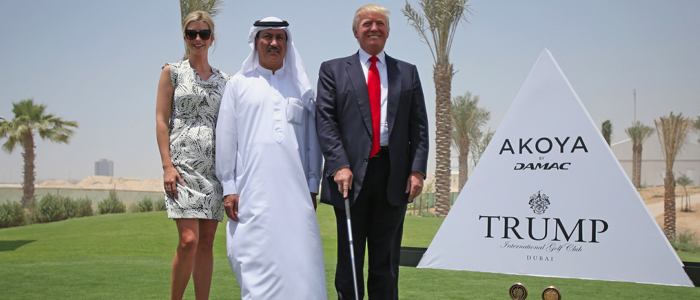
Leisurecorp has sold Turnberry golf resort to Donald Trump. The Dubai government unit, which paid a reported US$ 93 million for the Scottish complex in 2008, disclosed no details of the sales price but is probably less than what was paid for in those halcyon days. Maybe members of the upcoming Trump Akoya golf club in Dubai will get reciprocal rights to play on the iconic Open golf course.

Two bond issues occurred this week. The Dubai government placed a 15-year sukuk on the DFM which brings the total value of sukuks listed locally to US$ 20.4 billion. Majid Al Futtaim has issued a ten-year US$ 500 million bond, which has been heavily oversubscribed, priced at around 195 basis points.

Because of a supposed accessibility risk to international investors, MSCI is reportedly planning to cut the weightings of four stocks on the DFM. This comes ahead of their formal transfer of the UAE bourses from frontier market to emerging markets status later in the month. Consequently an adjustment factor will be placed on Emaar, Arabtec, Dana Gas and Dubai Islamic Bank. Nevertheless it is estimated that up to US$ 2 billion could flood into the local market as overseas investment increases.

The DFM fell back 0.2% from its Sunday opening of 5088 points to close on Thursday at 5078. Bellwether stocks, Emaar and Arabtec, were trading at US$ 2.69 – down US$ 0.25 on the week – and up US$ 0.08 at US$ 2.47 respectively. During April, the bourse moved northwards 13.6% from 4451 points to close the month on 5059. So far this year, the best performing global stock market has skyrocketed over 50% from its January opening of 3370.

Outsourcing company Serco has hit bad times since being found out last year that it was defrauding the UK exchequer. The scandal cost the firm US$ 113 million, a loss of consumer confidence and a ban on further government contracts. Now to replenish its dwindling finances, it plans to raise US$ 280 million in a placement of 9.9% of its stock. It is a wonder then that its market valuation has only halved in the past twelve months.

The UK economy is now growing at its fastest rate in seven years as Q1 growth figures reached 0.8% with the good news spread among all sectors including manufacturing at 1.3%. In comparison, the likes of Germany, France, Italy and Spain are faring a lot worse so much so that ECB president, Mario Draghi, has indicated that he may have to start a radical quantitative easing program.

Meanwhile in Washington, the Fed will continue to cut back a further US$ 10 billion to US$ 45 billion on its QE policy, despite US Q1 growth figures coming in at a miserly 0.1%.

Also this week, the US Treasury found out that it had lost US$ 11.2 billion on its US$ 49.5 billion 2008 bailout of General Motors.  Maybe Treasury spokesman, Adam Hodge, could have done better than his quote that the goal of Treasury’s investment in GM was never to make a profit! Since the Treasury sold its last remaining shares, in December, the company’s market cap has fallen 16% over the past four months as it has had to recall 2.6 million cars, with potentially faulty ignition switches, which could be linked  to at least thirteen deaths.

With Russia still calling all the shots in the Crimea, the IMF has approved a US$ 17 billion bail-out fund for Ukraine, with 20% immediately available and the balance paid out over the next two years. In return, Kiev will have to implement stringent and unpopular reforms which will see both oil prices and taxes increased. A further US$ 15 billion will become available from other sources including the World Bank and the EU.

It seems that the West is giving Vladimir Putin carte blanche to do as he wishes in the region as pro-Russian forces continue to take over many government buildings in Eastern Ukraine, with tens of thousands of troops stationed menacingly on the border. The only riposte seems to be minor economic sanctions on several Russian officials and a pledge to recover the billions of dollars allegedly stolen by the country’s ex-president Yanukovych. From Russia with Love.

Posted in Finance | Tagged , , , , , , , , , , , , , , , , , | Leave a comment

Fire and Rain

dubai-expo-siteEmaar Properties showed a US$ 235 million Q1 profit, up 55.2% year on year, on a 7% hike in revenue to US$ 615 million. Furthermore sales at US$ 1.61 billion were a massive 94% higher than the corresponding period in 2013. The company is still expected to raise up to US$ 2.5 billion in a secondary offering of shares in its Malls Group later in the year. The company has also signed a Memorandum of Understanding with Dubai World Central to develop a staggering 13.6 million sq mt residential estate adjacent to the Expo site.

The proposed Expo site at Jebel Ali, will be the largest ever and will cost in the region of US$ 3 billion. There will be a further US$ 7 billion earmarked for infrastructure, including US$ 1.4 billion to be spent on expanding the Metro’s Red Line.

A further project in Dubailand was announced by Dubai Properties. Condor Building Contracting won a tender to build a 20k sq mt retail and community centre in its Mudon location, due to open late next year.

It is reported that Dubai’s National Petroleum Services will be sold to a Gulf-based syndicate for up to US$ 700 million. The oilfield service company, which operates in the MENA region as well as Malaysia and Brunei, will have the likes of Arab Petroleum Investment Corporation and Fajr Capital among its new owners.

Dragon Oil, 51% owned by ENOC, is set to spend US$ 1.5 billion in surveying an Afghan oil concession, covering an area of almost 1.3k km.

It seems likely that the Dubai government will once again test the sukuk market with a US$ 500 million, 15-year, 5% Islamic bond. The last sovereign bond, issued in January 2013, was for US$ 1.25 billion and was 12 times over-subscribed. With the buoyant state of the local economy, more of the same is expected this time.

This week saw HH Sheikh Mohammed bin Rashid Al Maktoum on an official visit to Latin America with his seven-day whirlwind tour taking in Mexico, Chile, Argentine and Brazil. It is no surprise to see that these four countries were chosen as 2013 figures indicate a 25.4% annual leap in trade to US$ 4.71 billion. Mexico (US$ 2.2 billion) and Brazil (US$ 2.0 billion) were by far the largest trading partners.

The DFM had a massive week up 6.85% from its Sunday opening of 4762 points to close on Thursday at 5088. Bellwether stocks, Emaar and Arabtec, were trading at US$ 2.94 and US$ 2.38 respectively. No wonder the market is currently the best performing bourse in the world already 50.98% up this year from its 01 January opening of 3370 points. Traditionally, the market cools once the outside temperature rises and this could be welcome news.

UK bonus payments are back in the news with Barclays leading the pack. Despite a 32% fall in profits, the investment bank has actually increased its bonus pool by 10% to almost US$ 4 billion – almost three times the dividend pay-out to shareholders! Meanwhile retiring chairman of the gas conglomerate, BG Group, has walked away with a compensation package in excess of US$ 37 million. Despite dismal results and falling sales, Morrison’s chief executive, Dalton Philips, is in line for a US$ 3.8 million share bonus. These examples beg the question – who’s in charge?

One of the major success stories of modern times is Airbnb which started in 2008 and is now valued at US$ 10 billion. To date, the company, founded by Brian Chesky, Nathan Blecharczyk and Joe Gebbia, has facilitated accommodation for over 11 million customers in nearly 200 countries. Its main source of revenue is a 3% charge on all rentals made. Certainly a good role model for any of the local SMEs to follow.

There is no doubt that the Chinese economy is slowing and, with it, a marked escalation in their banks’ tapering and tightening of credit facilities to both local and international consumers. Allied with the fact that many international banks are becoming reluctant to lend money – and even closing clients’ accounts – this can only spell bad news for the global economy.

What is the world coming to when there is every possibility that the ECB may well cut central banks’ deposit rates to below the current zero level? This would mean that customers would have to pay banks for looking after their cash; if this were to happen, mattress sales would surely surge.

There is disturbing news from the Australian Bureau of Meteorology which has forecast that El Niño may start within the next three months. This weather pattern could have a disastrous effect on economies especially in those countries bordering the Pacific Ocean with a knock effect on trade and travel throughout the world.  As better financial news is beginning to filter through, this is not the best time for Fire and Rain.

Posted in Finance | Tagged , , , , , , , , , , , , , , , , | Leave a comment

Livin’ On The Edge

Palm-Jumeirah-BoardwalkNakheel has announced a tender for the design and construction of a 6 mt wide, 11 km long boardwalk on the outer side of the Palm Jumeirah crescent. It will also include two 100 mt long piers which will encompass dining and leisure facilities.

The developer has also appointed AE7 Associates to design and supervise the master planning of its 15.3 sq km development on Deira Island in a US$ 7.6 million contract. Like Palm Jumeirah, there will be a boardwalk included on the 4.5 million sq mt south island, as well as a shopping mall, ampitheatre and marina.

The Kuwaiti developer, Al Mazaya Holdings, is set to launch the second phase of its Q-Point residential development located in Dubailand. Q-1 is now almost 80% complete with hand-over slated within the next twelve months.

The Kuwait subsidiary of Dubai-based Drake & Scull has won two contracts totalling US$ 34.9 million for engineering work in that country.

Emaar Properties launched the latest phase of its Mir Oasis development in Arabian Ranches. Sales of the 480 townhouses will take place this Saturday at three locations – Dubai, Abu Dhabi and Karachi – and  strong investor demand is expected as Dubai’s property continues to boom.

At next week’s AGM, it is expected that Emaar will announce a cash dividend of US$ 0.041 per share together with a 10% bonus share issue. This follows a highly successful 2013 when the property developer announced profits of US$ 700 million on revenue of US$ 2.81 billion.

With the 80-day refurbishment of the runways at Dubai International due to start on 01 May, and the subsequent curtailing of some flights, Emirates has announced that it could lose up to US$ 272 million in revenue as it reduces flights to over forty destinations.

A useful indicator of the flourishing MICE sector is the increased activity recorded by Dubai World Trade Centre. In 2013, the number of both trade delegates – over 2.2 million – and the 373 exhibitions showed double digit growth. Nearly 900k of trade visitors came from overseas which has significantly helped growth in the hospitality sector.

April and May are expected to be bumper months for Dubai hotels. Still reeling from the influx of 19.5k Chinese visitors from one company Nu Skin, the industry is gearing up for Easter, the IPL and ATM – all expected to fill the current inventory of 85k rooms. It is estimated that both months will see over 1 million hotel visitors.

Inflation figures for both the UAE and Dubai continue to edge northwards which many expect to reach 3% by the end of the year, compared to 1.1% last year. Even then, the figures will be on the low side as home rents and education fees escalate at a much higher level.

Latest figures from Dubai Exports show that the fragrance, beauty and fashion-related industry is now worth in excess of US$ 56.1 billion – up over 8.0% on the year. By far the largest contributor was fashion which accounted for US$ 52.6 billion in 2013. Both the fragrance and cosmetics sectors showed double digit growth to US$ 1.50 billion and US$ 2.00 billion respectively. This week two new industry bodies – Fashion Group Arabia and Cosmetics Foundation Arabia – have been established.

The DFM had a relatively quiet week up only 0.04% from its Sunday opening of 4744 points to close on Thursday at 4762. Bellwether stocks, Emaar and Arabtec, were trading at US$ 2.79 and US$ 1.90 respectively. No wonder the market is currently the best performing bourse in the world already 41.31% up this year from its 01 January opening of 3370 points. More good news is imminent as the DFM is set to be reclassified to emerging market status in May which will result in extra liquidity entering the local market.

Certain European countries are facing difficulties in meeting their financial obligations. Portugal received a US$ 1.17 billion IMF / EU /ECB bailout payment this week which brings the total of the rescue package to US$ 25.7 billion over the past three years. The programme should have terminated in May but has been extended.

Meanwhile Italy has requested a further year to reach budget targets set as a condition for earlier funds. The country continues to struggle as its 2014 fiscal deficit is expected to reach 2.6% of GDP and its public debt is a massive US$ 2.9 trillion or the equivalent of 134.9% of GDP. The past three prime ministers, Berlusconi, Monti and Renzi promised balanced budgets by 2013, 2015 and 2016 respectively; 2020 is a more realistic assumption.

Greece’s unemployment rate continues at around the 28% level whilst its debt stands at 175% of GDP. There cannot be any sort of recovery there until steady economic growth returns to the country.

There is no doubt that things will have to get better not only for these three countries but most others in the eurozone. For too long now, they have been Livin’ On The Edge.

Posted in Finance | Tagged , , , , , , , , , , , , , , | Leave a comment