Against The Wind

cayan-tower-dubaiHH Sheikh Mohammed bin Rashid Al Maktoum is to develop a one-stop, full-service, commercial hub to accommodate the emirate’s rapidly developing fashion and design business. TECOM, a subsidiary of Dubai Holding, will operate the Dubai Design District and invest US$ 1.1 billion in phase 1, due for completion early 2015. Work on the initial ten buildings, located in Business Bay, has already started.

Emaar has also begun a 1 million sq ft expansion on the world’s largest shopping destination – Dubai Mall.  The centre, currently hosting 1,200 retail stores and 200 F&B outlets, will see added impetus to its fashion portfolio.

The building boom continues unabated with Emaar announcing two JVs.  The first, with Dubai Holding, is to build a 6.5 million sq mt urban centre – Dubai Creek Harbour – to include a business district along with retail, leisure and entertainment amenities. The other with Meraas Holding is to build a massive residential and commercial centre in Downtown. As yet, there is no news on the project cost, financing arrangements or completion date.

Damac have released the first of at least ten stages of their massive Akoya development, with villa prices starting at US$ 654k, scheduled for completion within two years. The project, that will eventually cover 2.8 million sq ft, is to include an exclusive Donald Trump golf course and be located off the Umm Suqeim Road.

Even previously troubled Dubai real estate firm, Deyaar has announced further plans for this year – as well as restarting on other unspecified, stalled projects. The first is a US$ 136 million Business Bay residential development whilst the second will be a 1 million sq ft project located on the SZR side of the same location. In Q3, it plans a sales launch of 420 apartments in DIFC – this being a JV with Dubai Properties Group.

With so much dramatic activity in the real estate sector are we in another property bubble? At the same time, the IMF has estimated government-related entities account for 65% of Dubai’s US$ 142 billion debt. Whilst the realty segment remains strong, lending costs low and oil prices high, this debt is probably manageable but what happens if circumstances change?

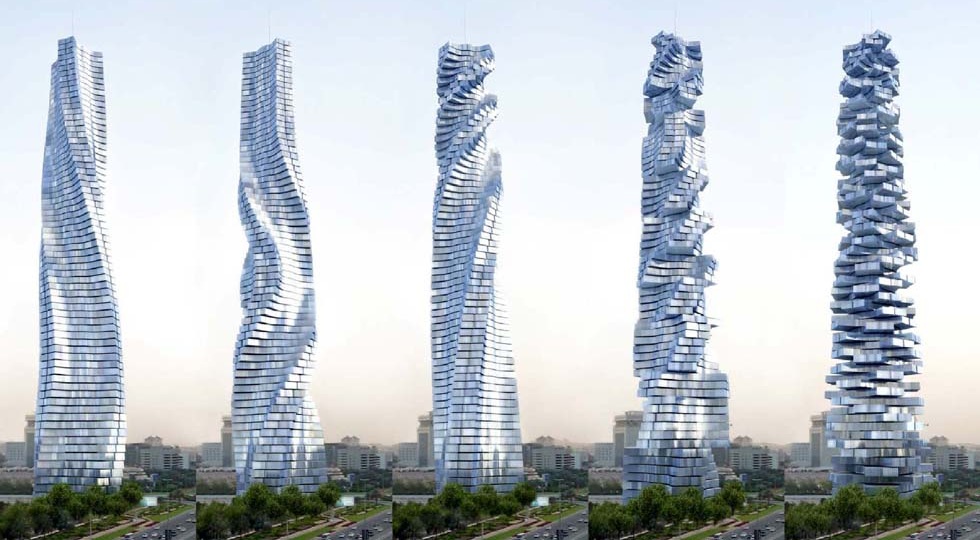
Another record for Dubai – this time boasting of being home to the tallest twisted building in the world. Located in Dubai Marina, the impressive 75-storey Cayan Tower is 307 metres high and cost US$ 273 million; its first tenants moved in to the 570 residential units this week.

The Investment Corporation of Dubai has raised US$ 2.55 billion through a syndicated loan for refinancing a US$ 2 billion debt due for repayment in August – the final repayment of a US$ 6 billion facility secured in 2008. Currently, demand for Dubai debt is robust and continues to grow.

A further sign of consumer buoyancy is an unprecedented surge in the local auto industry – up 22.9% in the first four months of 2013 to 118k units. Latest estimates show that this year will be the best ever with sales peaking at 380k. Whilst on the flip side, Europe continues their five-year contraction with vehicle sales lower than they were twenty years ago. As an aside, Dubai’s auto spares part foreign trade rose to a high of US$ 10.1 billion last year.

In London, Emirates is to open the world’s first aviation-themed attraction next month. Visitors will have the thrill of using any of the four flight simulators (two A380s and two 777s) and practice take-offs and landings. The state-of-the-art educational and infomational indoor facility covers 300 sq mt and is close to the airline’s other cable car attraction by the Thames.

Overseas, Arabtec will lead a three party consortium, along with Drake & Scull and CCC, to build the first phase of a tourism project in Aqaba, Jordan. The contract is valued at US$ 629 million and will include a man-made lagoon with four international hotels.

A recent cost of living report by ECA International has placed Dubai as the world’s 174th most expensive city, with Oslo, Luanda and Stavanger filling the top three positions. This may surprise many until they read the fine print, which indicated that rentals, school fees, car purchases etc were not included. The study mainly considered exchange rates, inflation and the availability of goods. That being the case, the report would appear to have limited value.

Another top trading month for the Dubai Gold and Commodities Exchange with May volumes of 1.45 million contracts totalling US$ 48.5 billion, up 70% on last year. Currency contracts accounted for 96.6% of the total with the Indian rupee again dominating the market. Expat Indians besieged financial institutions to take advantage as the rupee plunged to its lowest-ever level against the US$ at 56 to US$1.

Finally, after six years and perhaps not before time, Morgan Stanley Capital International (MSCI) upgraded UAE bourses from frontier to emerging market status, commencing next May. The knock-on effect for the Dubai Financial Market Index is that up to US$ 800 million could flow into the local capital markets, as investors, with an estimated US$ 7 trillion, follow MSCI market assessments. The effect on the DFMI was muted as it ended the week down 22 points to 2400 but overall the market is still heading north – up 54.15% this year and 69.24% over the past fifty-two weeks.

For the second consecutive year, UK-based Vodafone once again got away with paying no corporation tax in their home country, despite earning US$ 7.6 billion in Revenue.  However, it did manage to pay in excess of US$ 4.6 billion in overseas tax! Sadly the CEO, Vittorio Colao saw his annual remuneration slashed by 30% to a meagre US$ 17 million. Sadly, Thames Water, with revenue in excess of US$ 3 billion, joined the ranks of Amazon, Starbucks and Google in not paying any corporation tax to the UK exchequer. Something will have to change.

Meanwhile, official figures released this week indicate that Dubai’s 2012 GDP growth hit 4.4% to US$ 86.8 billion, with Q4 up an impressive 5.3%. The best performing sectors were transport, construction and real estate – all up by 7.5%, 6.5% and 6.1% respectively. This may slip to around 4.0% this year – still way above the World Bank’s estimates for Europe to contract by 0.6% and the global economy to rise by 2.2%. The growth forecast for China has been cut from 8.4% to 7.7% as the global slowdown shows no signs of improving – with the knock on effect of a reduction in demand for that country’s exports. Obviously it is time for the Chinese to start boosting their domestic market and undertake a long overdue reform of their economic structure.

The world’s stock markets fell on Thursday following yet another sell-off on Japan’s Nikkei 225 Index which has now dropped almost 22%, since hitting a five year high in early May. This is the third consecutive Thursday that market has dropped by more than 5% in a day. Questions are now being asked about the efficacy of Prime Minister Shinzo Abe’s brand of “Abenomics”.

The last word comes from the French President, Francois Hollande, who has unilaterally declared an end to the eurozone debt crisis. This revelation comes despite the fact that the bloc is still reeling from continuing high unemployment levels (currently standing at 19.4 million) and an on-going recession with Q1 returns showing a 0.2% contraction. Even the ECB President, Mario Draghi, has revised downwards 2013 growth forecast to contract by 0.6%. The IMF has warned France to introduce more economic reforms to stop it lagging even further behind its European neighbours. No wonder many think that M Hollande is p…… Against The Wind.

Posted in Finance | Tagged , , , , , , , , , , , , , , | Leave a comment

Shelter From The Storm

Emirates-Read-MadridThe major news story of the week came with the announcement that Dubal, 100% owned by the  Investment Corporation of Dubai, was going to merge with Emirates Aluminium (Emal) – a 50:50 JV between Abu Dhabi’s Mubadala and Dubal. The end result is that the new entity – Emirates Global Aluminium – will become the world’s 5th largest aluminium producer, with an annual capacity of 2.4 million tonnes, and have an estimated value of US$ 15 billion. This comes after Q1 global aluminium sales fell by over 10% and that up to 50% of producers are struggling to break even.

In line with recent property releases, Nakheel announced sales of US$ 381 million of its 350 Legacy Nova Villas within five hours of their Sunday launch. With such high demand, the property developer decided to increase the original number of 226 units to be sold by a further 50%. Construction will start later in the year and be ready by 2015.

Dubai largest developer, Emaar has indicated it will soon launch its ‘The Hills’ development with luxury homes being built around the obligatory 18-hole golf course. This comes on the back of a recent Deutsche Bank report indicating that the local real estate recovery has been on track for the past 16 consecutive months along with a 6.2% growth in Q1.

As an aside, the Indian government is reportedly accusing Emaar MGF – a JV between Emaar and the Indian company MGF Developments – of violating their forex regulations with investments of US$1.5 billion. The accusation stems from their various purchases of farmland since 2005 when the rules only allow investment in construction and development of property. (Its shares fell 1.7% to US$ 1.58 following this report).

Arabtec has been awarded a US$ 220 million contract to build a 5-star, 447-room hotel and 136-serviced apartments in Business Bay. The two-tower building, with a built-up area of 125k sq mt, is slated for completion by June 2015.

Part of SKAI Holding’s sales strategy is offering deed ownership on some of the 481 hotel rooms in its US$ 1 billion Viceroy Palm Jumeirah resort project which will also include twenty-one  apartments and six villas. Room costs will be in the region of US$ 450k – US$ 490k. Under the scheme, investors will receive 40% of revenue, paid out on a monthly basis, with an estimated 12% return. With such a return, it is little wonder that 50% of rooms have already been sold.

In the aviation world, IATA has just revised their previous forecast upwards in relation to ME carriers and expect them to report profits of US$ 1.5 billion in the coming year. On a global scale, profits are expected to come in at US$ 12.7 billion (US$ 7.6 billion in 2012) on Revenue of US$ 711 billion. This represents a net margin of 1.79% which equates to US$ 4 for every passenger flying.

Emirates have just spent part of their estimated US$ 272 million annual sponsorship budget by signing up Real Madrid in a five-year shirt deal plus certain other hospitality rights. A similar deal was initialled with New York Cosmos of the US MSL.

Dubai Summer Surprise is due to start this Friday with officials hopeful of topping last year’s Revenue of US$ 3.26 billion for the 32-day event. The 2012 festival attracted 4.36 million visitors of which 21.0% came from other countries. It is estimated that foreign tourists spent US$ 33 billion in the country last year and that the tourism sector contributed US$ 52.8 billion to UAE’s GDP.

A further indicator of the rising confidence in the local market was the latest PMI figures which rose from 54.0 in April to 55.3 last month. Any reading above 50 represents growth and the mid-term signs are that 2013 will be a lot stronger than last year. Furthermore, payroll numbers were up for the 17th consecutive month.

It can only be a matter of time for the Dubai Financial Market Index to slow down following another 2.3% weekly rise to close the shortened trading week on 2422 points – up from its Sunday opening of 2367. A market that has risen 75% over the past year would normally need dampening down and this is what will probably happen over the summer months – but not before another mini surge if there is an upgrade – from frontier to emerging market status – for the bourse next Wednesday.

Interesting statistics from The Boston Consulting Group show that 4% of all UAE households have private wealth in excess of US$ 1 million with UAE’s 2012 household wealth up by 8.2% with 57k families having a total value of US$ 400 billion. Overall the wealth held in equities, bonds and cash rose by 18.3%, 9.2% and 5.2% last year.

However a cloud in the Dubai summer sky may well be attributable to the actions of the US Federal Reserve chairman who could be held responsible for the sudden turnaround in the HSBC / Nasdaq Dubai US$ Sukuk Bond index. After showing moderate gains early in the year, and an impressive 15.1% in 2012, it is now down 0.5%. The main reason for this decline is that Ben Bernanke has indicated that QE may soon be coming to an end as the US economy starts to drag itself off the ground. This in turn may well see loans becoming more expensive for local entities.

As most of the world’s bourses headed south amidst renewed volatility, the Australian dollar was again sold off and ended the week at under 95 cents – some 11% down over the past two months. Q1 saw a further dip in investment and general weak economic data may force the Reserve Bank to reduce interest rates from their current level of 2.75%. There is no doubt that further trouble is brewing down under – especially as the mining sector slows – and turbulent times lay ahead.

Surprisingly in the UK the PMI for services confounded analysts’ expectations by rising from 52.9 to 54.9 in May showing that growth is now a lot higher than earlier forecasts. If this trend were to continue, Q2 growth could come in at 0.6% – double that of the previous quarter.

This is in contrast to the eurozone where the 17-member bloc continues in a recession that has now gone on for the past eighteen months; there was a 0.2% contraction in Q1 with Italy and Spain both shrinking 0.5%. Even the Bundesbank has cut its 2013 growth forecast down to 0.3% as the German economy suffers from its neighbours’ problems. The prospects for any recovery in the short-term are very fragile and a continuing downturn is almost inevitable as both regional and global demand dampens.

With the global economic malaise added to theregional political turmoil, no wonder Dubai has become a Shelter From The Storm.

Posted in Finance | Tagged , , , , , , , , , , , | Leave a comment

The Gambler

Dubai-Festival-CityAs the recovery in the emirate’s realty sector takes traction, Dubai’s biggest developer, Emaar Properties, has announced yet another launch for this weekend – 120 luxury apartments in its Burj Vista development. The two identical 20-storey towers will be located in the Downtown area.

Major retail developers, Al Futtaim Group Real Estate and Nakheel announced growth plans with the former adding eight new stores in Dubai Festival City with more expansion planned later in the year. Nakheel finally issued a tender for increasing the size of Ibn Battuta by 28k sq mt and adding 150 new outlets to its existing inventory of 270 shops and 50 restaurants. Contracts for its new US$ 681 million mall on Palm Jumeirah will be awarded within the next three months whilst phase 2 of its Dragon Mart will add a further 570  outlets by early 2014.

There are also reports that MAF may be interested in purchasing Abraaj Group’s share in the Spinneys ME franchise outlets excluding the UAE. Furthermore it expects to soon acquire Metro, the Egyptian supermarket chain, owned by the Mansour Group.

Emirates, along with the Canadian firm CAE, have just inaugurated a second pilot training facility in Silicon Oasis. The extra five full flight simulators will significantly enhance the airline’s pilot and technician training capacity. This is in addition to their Garhoud centre with its thirteen training bays, making it one of the largest of its kind in the world.

Dubai International reported April passenger numbers of 5.42 million and cargo of 200k tonnes – up 18.7% and 7.3% on the corresponding month in 2012. For the first four months of the year, passenger growth is up 16.3% to 21.9 million and cargo 11.5% to 704k tonnes.

Dubai Holding’s hospitality division, Jumeirah Group, is planning to take advantage of historically low interest rates by issuing a 6-year US$ 1.4 billion bond to finance future expansions including the US$ 680 million Jumeirah Madinat hospitality and shopping complex due for completion by 2015.

Likewise, it is no surprise to see reports that Majid Al Futtaim Holding is considering a bond sale – a week after buying the remaining 25% stake in Carrefour ME operations for over US$ 640 million. The company already operates fifty hypermarkets and forty-four supermarkets in the region under the Carrefour name and had 2012 revenue figures of US$ 5.9 billion.

The increased activity of Nissan in the Middle East is a reflection of the growing stature of the local car sector as its annual sales jumped by a whopping 26.2% with a 14.4% market share. Patrol and Sunny sales rose by 66% and 50% respectively.

This week HH Sheikh Mohammed bin Rashid Al Maktoum announced his Dubai Health Strategy 2013-2025 with plans to overhaul the emirate’s health sector including a major revamp of the existing Rashid Hospital. The  US$ 820 million redevelopment for the hospital include twin towers to house 600 patients, a 500-bed rehabilitation centre, two hotels and staff housing for 5,400 families.

Following the collapse of Lehman Brothers in September 2008, and the start of the GFC, the UAE Central Bank pumped in US$ 19.1 billion to shore up the local banks. The Commercial Bank of Dubai has now repaid its loan of US$ 408.7 million despite it not being due until the end of 2016. This follows hard on the heels of Emirates NBD repaying US$ 817.4 million last month. Such early repayments indicate how well the financial institutions have recovered from those dark days.

Signs of the good times returning to the UAE  were a 30%+ jump in the country’s 2012 current account balance to US$ 66.6 billion (with the surplus accounting for 17.3% of its GDP) and an impressive balance of payments surplus of US$ 10.0 billion. The country recorded a 15.9% surge in 2012 exports to US$ 350 billion comprising a 5.9% increase in hydrocarbons to US$ 118 billion and non-oil of US$ 232 billion. Total imports rose by 13.5% to US$ 222 billion.

With the value of oil at an average of US$ 112 last year, there are signs that this will drop to around US$ 105 in 2013. That being the case there will be a lag in revenue which will see revenue fall by around 3% and GDP may fall from 4.4% to 3.9%.

The Dubai Financial Market Index continues to defy gravity closing at the end of May on a high of 2367 points – with weekly, monthly, YTD and annual rises of 3.1%, 10.8%, 52.0% and 67.6%. These are impressive returns in anyone’s language but how long can it last? During the week, global equity markets saw renewed volatility which will continue into June mainly because of growing uncertainty about US monetary policy. Once again, Tokyo’s Nikkei 225 was down 5.2% on Thursday – slightly better than its 7.3% plunge a week earlier.

Overseas, Liberty Reserve’s founder, Arthur Budovsky and five others have been arrested and accused of aiding abetting criminals in illegal funds laundering more than US$ 6 billion. According to authorities, this could be the largest case of its kind in US history. The company operated as a virtual currency exchange and acted as a conduit for global cyber criminals to distribute and store their ill-gotten gains. Liberty’s virtual currency was used to trade illegal software designed to steal money from unsuspecting parties and financial institutions.

Two of the Big 4 accounting firms were in the news this week for the wrong reasons. Scott London, a former partner in KPMG, has pleaded guilty to insider trading in two companies that his firm audited – Skechers and Herbalife. This comes after his golfing partner had admitted receiving more than US$ 1 million in illegal profits as a result of London’s “advice”. The disgraced accountant is now facing up to twenty years inside as well as a US$ 5 million fine.

Deloittes have just appointed Dave Harnett as a tax consultant, ten months after he resigned as the UK’s top taxman with HM Revenue & Customs. This comes a week after several companies – including Amazon, Google Starbucks and Apple – were explaining why they paid so little UK tax. One of the main reasons was that tax experts found crucial loopholes in legislation – a definite tale of gamekeepers turning poachers.

Although no longer ruling the country, it is no surprise to see the earning power of four of the Labour grandees raking in money after life in  government. Gordon Brown, still an MP, is also a special UN envoy as well as chairman of the Policy and Initiatives Board of the World Economy Forum. Last year, he managed to earn an additional US$ 2.1 million.

Then there is BMM. Speculation around the ex-PM puts his personal wealth at over US$ 90 million, with most of this via his company, Tony Blair Associates, having apparent lucrative contracts with the likes of JP Morgan, Zurich Financial Services, the Korean UI Energy Corporation and the Kazakhstan government. Former Business Secretary, the Machiavellian Peter Mandelson has links with banking firm, Lazard Ltd, and is chairman of Global Counsel LLP a consultancy firm that advised Asia Pulp & Paper – a company linked with illegal logging and damaging habitat in Indonesia. Still recovering from his brother’s 2010 leadership coup, David Miliband has quit politics to take up a lucrative New York position as head of the International Rescue Committee.

What these examples illustrate is the cosy link between politics, big business, banks and quasi-government entities and the benefits that can accrue from contacts made (and probably assistance given) in the course of government work.

The eurozone crisis deteriorates by the day. Last month was the 24th consecutive month that the unemployment level rose in the bloc topping out at 12.6% in April with youth unemployment now at 24.4% as Greek and Spanish levels are at abysmal 62.5% and 56.4% respectively. Furthermore, twenty of the twenty-seven countries in the EU are on surveillance for breaking their own deficit and debt rules at 3% and 60% of GDP.

Even the European powerhouse, Germany, is struggling with a Q1 growth of just 0.1% (down 1.4% on the year) as exports and investments shrank.

Surprisingly, the UK is one of the best performing countries in Europe with growth rates of 0.8%. Despite this recent optimism, do not be surprised to see a mini devaluation (of around 10% to say Dhs 5 to the pound) over the coming months. With the departure of BoE Chairman Mervyn King, and the arrival of Canadian Mark Carney, there is a feeling that there will be a more aggressive approach to try and increase exports and UK competitiveness – and thus a weaker sterling currency. A sure case of the King of the Road being replaced by The Gambler.

Posted in Finance | Tagged , , , , , , , , , | Leave a comment

What’s Up?

Sydney-harbour-bridgeIn only its fourth year of operations, it seems that flydubai will be make an even bigger profit than the US$ 41.4 million made for the year ending 30 June 2012. Last year, the carrier saw passenger traffic at over 5.1 million accounting for 8.9% of all traffic at Dubai International. It now services 57 destinations and has a fleet of 29 Boeing 737s – with a remaining 23 on order for delivery before 2015. With such a rapid expansion, the airline is expected to make a substantial order – for either 737 Max or Airbus A320 neo – at this year’s Dubai Air Show in November.

On the aviation front, dnata has just acquired the remaining 50% in the Italian in-flight caterer, Servair Airchef. The company, part of the Emirates Group, will now have a presence at all the major Italian airports, providing more than 40k daily meals.

Tourism continues to be a major driver in the country’s economic recovery. The UN World Tourism Organisation’s latest report shows that the UAE was ranked 31 in the world for international tourism receipts raking in about US$ 10 billion out of a global total of US$ 1.04 trillion.

It is estimated that over 4% (or 400k) of all visitors to Dubai arrive by means of a cruise liner and this figure is set to grow in the coming years that might bring in US$ 270 million by 2015 and contribute up to 5% to Dubai’s GDP. This week saw the maiden call of the Royal Caribbean’s “Mariner of the Seas”, which can host over 3,800 passengers.

Another tourist attraction is taking shape in the Ilyas & Mustafa Galadari development, City of Arabia. The brothers plan to open a new four-zone 1.5 million sq ft theme park – IMG Worlds of Adventure – which will be the world’s largest indoor facility and be based on Marvel comic characters from Cartoon Network.

The influx of tourists is a huge boost for the retail sector with the emirate now ranked the second most important global retail destination after London. The recent CBRE report puts the likes of New York, Paris and Moscow behind Dubai. With twenty five new retail brands entering the local market in 2012, it  ranks as the world’s fourth “hottest” retail market.

The MAF Group spent US$ 680 million this week to purchase the remaining 25% minority share to gain full ownership of the French hypermarket Carrefour’s regional franchise, located in 19 countries. The company is looking at a further capital investment of up to US$ 1 billion this year.

After some considerable time, the stalled Lagoons project on Dubai Creek is back with confirmation that Dubai Holding is going to proceed with a JV – Emaar probably being the likely partner. The original US$ 17.4 billion plan was initially launched in April 2006 by Sama Dubai before that developer, along with Dubai Properties and Tamweer, came under the auspices of Dubai Holding in August 2009. The seven island development will have residential, retail and commercial property with unconfirmed reports of a tower bigger than Burj Khalifa.

Having recently announced three major developments in Dubai, Damac Properties have now begun construction of a 25-storey furnished apartment building in Baghdad. It is their first foray into the Iraqi market with the US$ 100 million Princess Tower due to be handed over in 2016.

Also overseas, Dubai-based Drake & Scull has been awarded a US$ 459 million Saudi contract to complete the Lamar Towers in Jeddah. The twin towers – with a total built up area of 410k sq mt – is expected to be ready in two years. DSI recently announced Q1 creditable results with Revenue and Profit up to US$ 334 million and US$ 17 million repectively.

Meanwhile Arabtec Terma, a 60:40 venture between the Dubai-based contractor and Greece’s Terma, has won a US$ 108 million bid to build a hospital in Riyadh. The six-storey, 105-bed hospital will be completed within two years. Saudi is becoming an important revenue stream for Arabtec and is a big contributor to its current backlog valued at US$ 5.7 billion.

Intermetal, the largest banquet and outdoor furniture company in the country, is planning to build a US$ 20.4 million facility in Dubai Investment Park. Costing US$ 20.4 million, the 300k sq ft factory will help this Group Harwal Company maintain its current 80% of the local market.

Starting the week at an impressive 2296 points, the Dubai Financial Market Index managed to hang on to its recent gains and was trading at the same level at close of trading on Thursday. There is no doubt that most global equity markets have seen growth (not necessarily at the same rate of Dubai) but there are indications that this may be coming to a shuddering halt as the train comes off the track.

Latest figures from the Ministry of Finance, for the first nine months of 2012, show a 14.4% hike in foreign trade to US$ 213.5 billion with imports jumping 12.6% to US$ 134.9 billion.  Total foreign trade for last year is expected to come in at around US$ 295 billion which would represent a 17% annual increase on the previous year.

However, there is a note of caution for 2013. The IMF is predicting that the robust growth of 5.7% seen in the region last year may slow to 3.2% this year. The obvious reason is that the global economic malaise will impact on oil production, the demand for which will fall. Despite this drop in the energy sector, non-oil growth will keep going on the same track at around 4.5%.

Not so good news this week for two Australians, Matt Joyce and Angus Reed. Both were found guilty by the Ruler’s Court on property fraud, charges involving Australian developer Sunland, over a multi-million Nakheel project. In addition, Joyce, the former GM of Dubai Waterfront, was fined US$ 25 million for his alleged role in the US$ 14 million fraud.

Although there are still embargoes on some of Zimbabwe’s diamond trade, it seems that up to a half of their exports of US$ 865 million will come through Dubai; most of which will then be re-exported to the likes of India, Belgium and China. The Robert Mugabe nation has had previous problems with “blood diamonds” but restrictions have been lifted for most sites with the exception of Marange.

Three major driving forces in the local economy are planning new loan deals. Atlantis, The Palm, owned by Istithmar and still managed by Kerzner International Resorts, is raising US$ 850 million for both refinancing existing debt and for new funding. Commercial Bank of Dubai, 20% owned by the Investment Corporation of Dubai, is launching a US$ 500 million five-year bond issue, the proceeds of which will be used for general corporate business. Emirates NBD launched a Tier1 US$ 1 billion bond with a 5.75% yield; Tier 1 capital represents the bank’s core capital introduced under the Basel Banking industry regulations.

Despite some worries about whether Dubai will meet its debt obligations over the next three years, the IMF has no such qualms. The estimated repayments are in the region of US$ 48 million and represent almost 100% of the emirate’s GDP. Officials have strategies in place, including the possibility of asset sales and debt rescheduling, to ensure that this does not become a major problem.

The global financial scandals continue unabated. This time the Hong Kong Mercantile Exchange – which deals mainly in gold and silver future contracts – is under investigation by local authorities for “serious suspected irregularities”.

In addition to its economic woes – including no growth and high unemployment – it is estimated that the EU loses a massive US$ 1.3 trillion a year to tax evasion. The main offenders are multinationals (such as Apple, Google, Starbucks and Amazon), rich individuals and parasitical tax havens including Andorra, Liechtenstein, Monaco, San Marino and Switzerland.

Clouds are appearing on the Australian economic landscape as its currency continues to fall (almost 7% so far in May) and the stock market takes a battering, losing US$ 33 billion in Thursday’s trading. External factors, including a surprise contraction in Chinese manufacturing and the almost inevitable prospect of QE being phased out in the US, have not helped the Australian cause. According to a recent report, commodity price volatility accounted for a US$ 25.6 billion fall in 2012 earnings across the country’s once booming resources sector.

Last week, Treasurer Wayne Swan announced a US$ 19.4 billion budget deficit and a US$ 43 billion four-year public spending cut. Although the country escaped the worst of the GFC, consumer confidence has now plummeted with car sales being one sector hit badly.

With its costs double that of Europe and quadruple of Asia, as well as its employees earning twice as much as their US counterparts, Ford has decided to close its two Australian plants after an 88-year presence. The American company has also made losses of US$ 580 million over the past five years, When one also considers that the three main manufacturers – Ford, GM and Toyota – now sell less than half the vehicles than they did in 1970, and that the state governments have poured in US$ 11.6 billion in subsidies since 2003, the local industry is obviously commercially unviable. Furthermore at the beginning of May, the Australian dollar was 29% higher against the Japanese yen compared to a year earlier.

Ford is a good example of the need for the country to stimulate its competitiveness on the global stage. Australia will also need to take measures to revive its ailing tourism and retail sectors. For a country that has not seen a recession for 21 years, has grown 13% since the GFC (whilst most other countries have gone backwards) and has an enviable unemployment rate of 5.5%, some analysts are now asking What’s Up?

Posted in Finance | Tagged , , , , , , , , , , , , | Leave a comment

I Started a Joke

dubai-frameFollowing their 2011 joint announcement, it seems that the Investment Corporation of Dubai-Brookfield real estate fund will soon become a reality. Both entities have agreed to seed the US$ 1 billion fund and will primarily invest in the local market and especially in development opportunities. This could be an excellent time to start such a venture as Q1 figures from Dubai Land Department indicate a 63% rise in transactions totalling US$ 12.0 billion.

A sign of the burgeoning population in Dubai can be gleaned from the fact that enrolments in the emirate’s private schools rose by 8.7% last year to almost 225,000. No wonder then that their 2012 total revenue was US$ 1.09 billion (up a staggering 16.3%). There is no doubt that the cost of education is sky-rocketing and causing much concern among the expat population. Although the average annual tuition fee is put at almost US$ 5k, the top end of the market charges in excess of US$ 26k.

The retail sector received a further boost with news of luxury retailer, Chalhoub Group, announcing a 20% growth last year in the UAE. It is planning to open a further fifty stores here this year, as part of its 150-store expansion in the region, bringing its total outlets to 600.

This week’s launch by property developer Emaar will not cause the usual Dubai chaos. The Address Residence Sky View II will only be open to residents of London, Doha and Riyadh in an on-line sale. Construction of the 50-storey hotel and residential apartments will start in Q3 and is slated for completion by the end of 2016.

Palm Jumeirah will be the location for yet another luxury hotel with SKAI Holdings announcing plans for a US$ 1 billion project to be managed by the Viceroy Group. This will be the operator’s first Dubai venture and the 481-room hotel, with 221 apartments, will be ready within three years.

A good indicator of the current confidence in the realty sector is the fact that the recently launched Damac’s Paramount- branded development has already sold 40% of the US$ 680 million project.

The Dubai-based investment bank, Shuaa Capital, is still in the red with Q1 losses at US$ 1.6 million but an improvement on the US$ 2.3 million loss recorded over the same period in 2012. There was a 34.2% fall in Revenue to US$ 9.9 million as well as a 7.1% drop in Total Assets to US$ 354 million.

Although there are still six months until the host city for Expo 2020 is announced, a recent report has outlined the benefits for Dubai if their bid were successful. They include the addition of 280,000 new jobs of which 53% would in the travel and tourism sector, as well as the prospect of a massive inflow of 25 million visitors.

One visitor attraction, highlighting both old and new Dubai, will be completed within twelve months. The US$ 32.7 million completely transparent Dubai Frame – a 150 meter tall window frame, located in Zabeel Park – will feature a museum and will have elevators so that visitors can view the emirate from the top of the structure.

The Dubai Financial Market Index is still heading north with a massive weekly 5.4 % rise from 2178 to 2296 points. What has become the fastest growing exchange in the world has seen a 48.45% rise in 2013 and 64.29% surge in the past year. The other local bourse, Nasdaq Dubai, started the week with only two companies trading – Depa and DP World. It ended the week with only the latter as shares in Depa were suspended on Tuesday following their AGM at which its largest shareholder, Arabtec, with 24% holding, attempted to gain more board representation.

Rather surprisingly to many, Dubai’s April inflation rate was a paltry 0.1% whilst nudging up to 0.9% for the year. Rising rents and other price hikes have yet to impact on the emirate’s CPI.

Dubai’s non-oil trade expanded in Q1 by 16.3% from US$ 76.3 billion in 2012 to US$ 88.7 billion – and this despite regional unrest, a reduction in trade with Iran and an on-going global economic slowdown.

As the Reserve Bank of Australia cut interest rates to 2.5% – and with inflation at 2.25% – the Australian dollar is hovering below parity against  the greenback for the first time in over a year. Political uncertainty and a tentative economic climate, as mining sector revenues fall, were the background for what was probably Treasurer Wayne Swan’s sixth and final budget.

Following a US$ 17 billion hit to his revenue forecast, Tuesday’s patchwork budget saw the start of a four-year US$ 43 billion spending cut which will see this year’s US$ 19.4 billion deficit return to a supposed surplus by 2018. There seems little to support the country’s ailing retail and tourism sectors and even less to revive its competitiveness on the world stage.

Despite all this, Australia is still the lucky country when compared to most nations in Europe where recession in the eurozone continues for the sixth straight quarter. Q1 saw the 17-country bloc contract by a further 0.2% with Germany just managing a very weak 0.1% growth. Add to this the rising unemployment problem, with over 19 million looking for work, then it is reasonable to assume that there is worse to come. A good example is Tata Steel which has just written off US$ 1 billion of the value of its operations as it saw steel European steel demand fall 8% last year (and 30% since 2008).

Over the past few years, major scams have been unearthed – and they have usually involved individuals. Now there seems to be a tendency for institutions to become embroiled in fraudulent activities with many putting their corporate snouts into the trough. Just look at sporting organisations, big business, banks and the oil industry.

The fraudulent shenanigans at FIFA, headed by the roguish-looking Sepp Blatter, seem to be a regular occurrence whilst the Thursday’s IPL scandal is the latest to tarnish the game of cricket. Meanwhile Monsanto is once again apparently attempting to gain exclusive control of what many would consider to be everyday fruit and vegetables. Banks have shown their true colours with their disgraceful fat cat bonuses, Libor rate fixing, money laundering and now, potentially their biggest faux pas, price rigging interest rate swaps.

Joaquin Almunia, the EU’s antitrust commissioner, is investigating allegations of oil price fixing by some of the world’s biggest energy companies. There are concerns that, for many years, companies have colluded in reporting distorted prices which resulted in the end consumer paying more at the pump. (Maybe they can also look at other markets such as gold and currency).

Finally, Amazon’s UK subsidiary had sales of US$6.5 billion in 2012 and received government grants in the region of US$ 3.8 million. The on-line retailer employs 4,200 and has a tax bill of just 0.1% or US$ 3.7 million. Their theme song has to be I Started a Joke and the joke is on the UK taxpayers!

Following their 2011 joint announcement, it seems that the Investment Corporation of Dubai-Brookfield real estate fund will soon become a reality. Both entities have agreed to seed the US$ 1 billion fund and will primarily invest in the local market and especially in development opportunities. This could be an excellent time to start such a venture as Q1 figures from Dubai Land Department indicate a 63% rise in transactions totalling US$ 12.0 billion.


A sign of the burgeoning population in Dubai can be gleaned from the fact that enrolments in the emirate’s private schools rose by 8.7% last year to almost 225,000. No wonder then that their 2012 total revenue was US$ 1.09 billion (up a staggering 16.3%). There is no doubt that the cost of education is sky-rocketing and causing much concern among the expat population. Although the average annual tuition fee is put at almost US$ 5k, the top end of the market charges in excess of US$ 26k.


The retail sector received a further boost with news of luxury retailer, Chalhoub Group, announcing a 20% growth last year in the UAE. It is planning to open a further fifty stores here this year, as part of its 150-store expansion in the region, bringing its total outlets to 600.


This week’s launch by property developer Emaar will not cause the usual Dubai chaos. The Address Residence Sky View II will only be open to residents of London, Doha and Riyadh in an on-line sale. Construction of the 50-storey hotel and residential apartments will start in Q3 and is slated for completion by the end of 2016.


Palm Jumeirah will be the location for yet another luxury hotel with SKAI Holdings announcing plans for a US$ 1 billion project to be managed by the Viceroy Group. This will be the operator’s first Dubai venture and the 481-room hotel, with 221 apartments, will be ready within three years.


A good indicator of the current confidence in the realty sector is the fact that the recently launched Damac’s Paramount- branded development has already sold 40% of the US$ 680 million project.


The Dubai-based investment bank, Shuaa Capital, is still in the red with Q1 losses at US$ 1.6 million but an improvement on the US$ 2.3 million loss recorded over the same period in 2012. There was a 34.2% fall in Revenue to US$ 9.9 million as well as a 7.1% drop in Total Assets to US$ 354 million.


Although there are still six months until the host city for Expo 2020 is announced, a recent report has outlined the benefits for Dubai if their bid were successful. They include the addition of 280,000 new jobs of which 53% would in the travel and tourism sector, as well as the prospect of a massive inflow of 25 million visitors.


One visitor attraction, highlighting both old and new Dubai, will be completed within twelve months. The US$ 32.7 million completely transparent Dubai Frame – a 150 meter tall window frame, located in Zabeel Park – will feature a museum and will have elevators so that visitors can view the emirate from the top of the structure.


The Dubai Financial Market Index is still heading north with a massive weekly 5.4 % rise from 2178 to 2296 points. What has become the fastest growing exchange in the world has seen a 48.45% rise in 2013 and 64.29% surge in the past year. The other local bourse, Nasdaq Dubai, started the week with only two companies trading – Depa and DP World. It ended the week with only the latter as shares in Depa were suspended on Tuesday following their AGM at which its largest shareholder, Arabtec, with 24% holding, attempted to gain more board representation.


Rather surprisingly to many, Dubai’s April inflation rate was a paltry 0.1% whilst nudging up to 0.9% for the year. Rising rents and other price hikes have yet to impact on the emirate’s CPI.


Dubai’s non-oil trade expanded in Q1 by 16.3% from US$ 76.3 billion in 2012 to US$ 88.7 billion – and this despite regional unrest, a reduction in trade with Iran and an on-going global economic slowdown.


As the Reserve Bank of Australia cut interest rates to 2.5% – and with inflation at 2.25% – the Australian dollar is hovering below parity against  the greenback for the first time in over a year. Political uncertainty and a tentative economic climate, as mining sector revenues fall, were the background for what was probably Treasurer Wayne Swan’s sixth and final budget.


Following a US$ 17 billion hit to his revenue forecast, Tuesday’s patchwork budget saw the start of a four-year US$ 43 billion spending cut which will see this year’s US$ 19.4 billion deficit return to a supposed surplus by 2018. There seems little to support the country’s ailing retail and tourism sectors and even less to revive its competitiveness on the world stage.


Despite all this, Australia is still the lucky country when compared to most nations in Europe where recession in the eurozone continues for the sixth straight quarter. Q1 saw the 17-country bloc contract by a further 0.2% with Germany just managing a very weak 0.1% growth. Add to this the rising unemployment problem, with over 19 million looking for work, then it is reasonable to assume that there is worse to come. A good example is Tata Steel which has just written off US$ 1 billion of the value of its operations as it saw steel European steel demand fall 8% last year (and 30% since 2008).


Over the past few years, major scams have been unearthed – and they have usually involved individuals. Now there seems to be a tendency for institutions to become embroiled in fraudulent activities with many putting their corporate snouts into the trough. Just look at sporting organisations, big business, banks and the oil industry.


The fraudulent shenanigans at FIFA, headed by the roguish-looking Sepp Blatter, seem to be a regular occurrence whilst the Thursday’s IPL scandal is the latest to tarnish the game of cricket. Meanwhile Monsanto is once again apparently attempting to gain exclusive control of what many would consider to be everyday fruit and vegetables. Banks have shown their true colours with their disgraceful fat cat bonuses, Libor rate fixing, money laundering and now, potentially their biggest faux pas, price rigging interest rate swaps.


Joaquin Almunia, the EU’s antitrust commissioner, is investigating allegations of oil price fixing by some of the world’s biggest energy companies. There are concerns that, for many years, companies have colluded in reporting distorted prices which resulted in the end consumer paying more at the pump. (Maybe they can also look at other markets such as gold and currency).


Finally, Amazon’s UK subsidiary had sales of US$6.5 billion in 2012 and received government grants in the region of US$ 3.8 million. The on-line retailer employs 4,200 and has a tax bill of just 0.1% or US$ 3.7 million. Their theme song has to be I Started a Joke and the joke is on the UK taxpayers!


Normal
0

false
false
false

EN-US
X-NONE
X-NONE

/* Style Definitions */
table.MsoNormalTable
{mso-style-name:”Table Normal”;
mso-tstyle-rowband-size:0;
mso-tstyle-colband-size:0;
mso-style-noshow:yes;
mso-style-priority:99;
mso-style-parent:””;
mso-padding-alt:0in 5.4pt 0in 5.4pt;
mso-para-margin:0in;
mso-para-margin-bottom:.0001pt;
mso-pagination:widow-orphan;
font-size:11.0pt;
font-family:”Calibri”,”sans-serif”;
mso-ascii-font-family:Calibri;
mso-ascii-theme-font:minor-latin;
mso-hansi-font-family:Calibri;
mso-hansi-theme-font:minor-latin;}

Posted in Finance | Tagged , , , , , , , , , , | Leave a comment

What’s Going On?

Emirates-a380-terminal-dubaiPrior to the start of Arabian Travel Mart, HH Sheikh Mohammed bin Rashid Al Maktoum officially approved Dubai’s 2020 Vision for Tourism, which would see visitor numbers double to 20 million within the next seven years. The local tourist board, DTCM, will focus on three key drivers – promoting Dubai as the destination for families, events and business gatherings.

The most recent figures indicate that the Dubai hospitality sector showed a 17.9% annual growth in revenue to US$ 5.1 billion with a present inventory of 599 hotels and hotel apartments comprising 80,000 rooms.  Tourism is estimated to contribute over US$ 76 billion to the region’s economy and is responsible for around 14% of the UAE’s GDP.

Some pundits are becoming worried about the prospect of another property bubble in Dubai but latest figures show that it trails in at fourth in the ranking of global luxury home price increases over the past year. Its 18.3% annual increase was well behind the top three of Jakarta (38.1%), Bangkok (26.1%) and Miami (21.1%) with Tokyo seeing a 17.9% plunge as most European cities continue to fall.

Salim Al Moosa’s Falconcity of Wonders received a boost this week with the announcement of the design and supervision of two of the three pyramid buildings which will house a large hotel along with both luxury residential and office units. These pyramids will be part of a development that will eventually include full-size replicas of the likes of the Taj Mahal and Eiffel Tower.

Nakheel confirmed that its recent launches, Jumeirah Park and Jumeirah Village Circle, had sold out the total of 417 units, with sales of US$ 518 million recorded. Its Q1 revenue was at US$ 595 million – a 61.9% surge whilst quarterly profits were up 31.6% to US$ 134 million.

Despite recent good news, Dubai World still faces problems with a US$ 4.5 billion loan repayment due in 2015 and a further US$ 10 billion three years later; this being part of the 2011 US$ 16 billion debt restructuring plan that saved the company from going under. In the unlikely event that it has to sell off some of the family silver, it does have several high profile assets such as the Mandarin Oriental in New York, CityCenter Casino and Hotel in Vegas, Atlantis Hotel on the Palm, DP World and Cirque du Soleil.

It seems that Dubai Group has restructured a US$ 10 billion debt with its creditors and at the same time become an independent entity from HH Sheikh Mohammed bin Rashid Al Maktoum’s investment arm, Dubai Holding. Although Dubai Group is expected to sell some of its assets, but not the likes of its shares in Dubai Bourse, 14.7% in Bank Muscat and 18% in EFG Hermes, the restructuring will see creditors’ repayment schedules extended.

Meanwhile the QE2 initially bought in 2007 by Istithmar, a subsidiary of Dubai World, still remains in local waters for at least three more months prior to sailing to Singapore for fit out and then ending its days as a floating hotel in Hong Kong. That is the latest plan but there are moves afoot, by some UK investors, to have the cruise liner return to London and be moored on the Thames as a tourist attraction.

As expected, Emirates surpassed market expectations with a stellar 52% profit growth to US$ 622 million on a 17% jump in revenue to US$ 19.9 billion. Over the year ending 31 March 2013, the airline carried 39.4 million passengers on its 200 aircraft with an impressive 80% load factor. Despite the global slowdown in trade, Emirates still had a strong year with an 8% jump in cargo revenue to US$ 2.8 billion and tonnage up 16% to 2.1 million tonnes.

Although future prospects are bright, Dubai Aerospace Enterprise saw Q1 profits plunge from US$ 121 million to US$ 7.3 million over the same period last year. This disappointing news came despite a 7.8% increase in Revenue to US$ 1.94 billion. The company, which employs over 4,000, has a fleet comprising of fifty aircraft including 10 Boeing 777s and 16 737s as well as 15 Airbus A320s and 11 A330s.

With the last of quarterly results being released, Mashreq saw a spectacular 57.1% increase in Q1 profits to US$ 115.9 million. The bank has consolidated its growth trend as this result follows a 60% jump in profits last year.

Yet again, UAE consumers have been rated as the most confident in the area despite its Q1 level dropping five points to 108. This is still well above the global average of 93 and streets ahead of Europe’s abysmal showing of 71. UAE saw its rating similar to China and Hong Kong but behind the leader, Indonesia (122 points), followed by India, Philippines, Thailand and Brazil. Any ranking above 100 on this Nielsen Survey indicates increasing degrees of consumer optimism.

It may be of interest to note that the UAE is now the global leader in relation to FTTH (fibre to the home) network with a penetration rate of 72%. South Korea is its nearest rival at 57% with Japan, Russia, USA and France close behind. Etisalat has spent US$ 5.2 billion in the network to get the country to its current position.

A sign of increased economic activity was a March monthly 1.0% increase in money supply MO (basically currency) to US$ 16.2 billion whilst money supply aggregate M1 (currency plus banks’ current and call accounts) rose 3.2% to US$ 89.2 billion. Total bank deposits rose at a higher rate than loans – 2.0% to US$ 337.3 billion compared with 0.7% to US$ 306.8 billion.

The Dubai Financial Market Index continues its upward spiral – gaining 2.1% this week to close on 2178 points. It may be a little late to jump on this particular bandwagon as the market has already risen 40.8% in 2013 and 53.5% over the past year.

The unelected mandarins that have helped the eurozone become the focal point of the economic malaise have finally come to their senses. After three years of espousing the doctrine of austerity for its members – and in the process tearing apart the fabric of society in many countries – they have finally determined they got it wrong. Now Olli Rehn, the EU Economic Affairs Commissioner, has decided, in his infinite wisdom, that three of the five largest economies – France, Spain and the Netherlands – will be given more time to attain previously agreed deficit targets including getting annual budget deficits down to  3%. Growth – rather than austerity – seems to be the new message coming out of Europe.

Latest estimates show that five of the seventeen member eurozone bloc have sovereign debt levels of over 100% of GDP with Greece leading the way at 175% followed by Italy (132%), Portugal (124%), Cyprus (124%) and Ireland (120%). What is more worrying is that the level for the whole bloc may reach 96% by next year. Compare this to the UAE where their debt level is an estimated 16.46%!

A major area of concern has to be the amount of “easy” money that has been added by the monetary easing policy of many governments. This unparalleled flow of cash into the global economy is a sure-fire recipe for an eventual overheating of economies and the formation of inevitable asset bubbles – whether it be in stocks, commodities or property. The state of the global equity markets is a case in point – how can shares rise so much when the world economy seems to be going in the other direction?  What’s Going On?

Posted in Finance | Tagged , , , , , , , , , , , , , , | Leave a comment

Tell Me When

Lost-Valley-DubaiLatest figures coming out of Dubai Land Department show that Q1 residential transactions reached US$ 1.28 billion – a 51.6% hike on corresponding 2012 returns. The total number of realty transactions was even more impressive with 14,260 transactions amounting to almost US$ 12 billion – a rise of 63.0% on the same period last year. 2012 transactions were up 7.7% on the year reaching 41,800 and totalled US$ 42 billion. If that does not indicate the strength of the bounce back in this sector, nothing will!

Following their November 2012 announcement, a joint venture agreement between Meydan and the Sobha Group was formally signed this week. The development, covering 4 million sq ft, will include 1,000 hotels, the world’s largest shopping mall and an open recreational area, 30% larger than London’s Hyde Park. Phase 1 will feature 1,500 high end villas and 7 km of lagoons. An estimated US$ 5.7 billion is expected in property receipts.

In February, Damac published details of a US$ 1 billion development with Paramount Pictures. Now they have come up with their largest ever project, Akoya, which will cover 29 million sq ft and comprise luxury residences, an 18-hole PGA Championship golf course and the usual accoutrements associated with Dubai projects.

After being on the back burner for some time, IMG Group (Ilyas & Mustafa Galadari) has resurrected plans for a dinosaur theme park with the Lost Valley boasting robotic dinosaurs and the largest temperature controlled indoor entertainment space in the world. This will be their third park in the same location, with the other two being based on Marvel Comic and Cartoon Network characters.

Developer, Seven Tides, has announced the initial launch of its Anantara project on Jumeirah Palm, comprising 442 luxury apartments (ranging in size from 1,158 to 1,524 sq mt) and 14 penthouses. The development will be in conjunction with the 293-room Anantara hotel due to open this September.

Although the residential, hospitality and retail property sectors are experiencing a renaissance, one sector that is lagging behind is office space. In certain areas, such as Business Bay and Silicon Oasis, 50% of inventory is vacant and, with new projects coming on stream, the problem is set to worsen. Indeed some developments in Business Bay have already converted former office towers to housing units.

Following on from last week’s update on the new zoo project, Dubai is now planning a hotel for dogs and cats. The facility is part of a birds’ market project, costing US$ 14.7 million, and will be completed by year end. Located in the Al Warsan area, the “hotel” will cover 835 sq mt.

To keep the other type of hotels busy during summer, there is an-going three-month “Summer in Dubai” campaign with the aim of making the emirate the ultimate family destination of choice. Apart from Dubai Summer Surprises and Modhesh World, there will be a range of events such as Dubai Rock Festival and Dubai Sports World.

Next week will see the 20th edition of the Arabian Travel Market with the four day event attracting more than 20,000 trade visitors and 2,500 exhibitors. The region’s biggest travel and tourism event will help showcase Dubai’s booming hospitality sector to professionals from over 100 countries.

No surprise to see that March passenger traffic at the world’s second busiest airport jump 20.6% from a year earlier to 5.8 million and a YTD increase of 15.6% to 14.26 million. March cargo figures increased by 14.7% to 185k tonnes whilst YTD shows a 13% jump to 585k tonnes, at a time when global cargo figures continue in decline.

There was mixed news from Emaar with Q1 profit of US$ 151 million, down 8% on the same period in 2012 but 9% up on Q4 2012. This drop in profit came despite a 16% increase in revenue to US$ 575 million, 55.3% (US$ 318 million) of which came from its retail, hospitality and leisure sectors.

In similar vein, Arabtec Holding saw its Q1 profits drop by 26% to US$ 17.0 million, despite a 20% rise in Revenue to US$ 422 million. A tightening of margins saw its Gross Profit drop by 9% to US$ 52.0 million but an expanding project backlog should see better returns later in the year.

Drake & Scull appeared to fare better with a 47% increase in Q1 profits to US$ 17.2 million on revenues of US$ 334 million. 78% of the revenue came from operations in Saudi Arabia (59%) and UAE (19%) whilst its order backlog at 31 March was up 17% to US$ 2.45 billion.

Meanwhile Deyaar Development reported a Q1 net profit of US$ 5.3 million – well up on the US$ 2.6 million the corresponding period last year.

Du, the UAE’s second telecom provider, benefitted from a double whammy of increased Q1 revenue (7.3% up to US$ 717 million) and reduced costs to see their net profit jump 40.5% to US$ 127.5 million. With such impressive results and a 19.9% annual increase in mobile subscribers, it is no shock to see its shares up by 46.9% in the first four months of the year.

The Dubai-listed district cooling firm, Tabreed, partly owned by the capital’s state fund, Mubadala, reported a 29.9% hike in Net Profits to US$ 13.0 million as chilled water revenue rose by 5% to US$ 55.2 million. Two years ago, the company secured an US$ 845 million finance package from Mubadala and last December it agreed to issue US$ 308 million worth of convertible bonds as part of its recapitalisation strategy – this has resulted in Q1 finance costs falling to US$ 105 million.

The Dubai Financial Market Index closed the week’s trading at 2129 – up 2.6% this week following Sunday’s opening of 2076. What must be one of the world’s best performing bourses this year has seen a stellar rise of 37.64% in the first four months of 2013 and 41.37% over the past fifty two weeks.

Habtoor Leighton Group secured a welcome US$ 68.1 million contract for the design and construction of two camps for the Satah Al Razboot oilfield development in Abu Dhabi.

Within the next five years, it is expected that the MENA region will spend in excess of US$ 740 billion in the energy sector with UAE accounting for 14.5% of that spend at a staggering US$ 107 billion – second only to Saudi Arabia’s US$ 165 billion.

on the European front, the Greek parliament finally caved in to the troika’s demands and passed a bill that would see the dismissal of 15,000 civil servants. To date, the country has received US$ 314 billion in rescue loans since 2010 and needed to pass this legislation to unlock a further US$ 11.5 billion by 20 May.

Spain’s economy continues to shrink with a 0.5% Q1 fall in GDP and an unemployment rate – currently at 27.16% – that is spiralling out of control. The country is eurozone’s fourth largest economy and is firmly entrenched in a double dip recession which many believe will take years to overcome despite Mariano Rajoy’s government forecasting very weak growth in 2014. Furthermore public deficit will reach 6.3% of its GDP – much larger than the 4.5% initially targeted as well as the 3.0% EU agreed ceiling.

Once again unemployment levels hit new records in March with 12.1% of the working population unable to find work in the EU. Even more disturbing was the fact that 25% of those under 25 are unemployed with the likes of Greece and Spain recording figures of a frightening 60%. How did governments allow this to happen in the first place and when will they take measures to diffuse this ticking time bomb?

This week, the ECB decided to cut its interest rates by a third to a record low of 0.5% as the eurozone continues to be buffered by economic problems. It is worrying that three of the largest eurozone economies – Germany, France and Italy – are seeing marked declines in confidence levels which indicates that the outlook is still dismal and no immediate end to the recessionary cycle is in sight. As eurozone GDP continues in contraction, it can only be a matter of time until we see customers having to pay banks to deposit their funds, i.e. negative interest. Even then would banks be more concerned protecting their own interests rather than trying to help kick-start economies by loaning money to the likes of SMEs?

When will eurozone bureaucrats and the ECB President, Mario Draghi, wake up to reality and realise that some of the bloc’s economies are heading towards banana republic territory? Tell Me When.

Posted in Finance | Tagged , , , , , , , , , , , , , , , , , | Leave a comment

In Dreams

kibera-shanty-townNobody seems to know how many new housing units will come on line this year, with estimates of between 12k and 48k but some figure like 25k a plausible outcome. This would see a 7% increase in supply, mainly to be found in the “newer” areas of Dubailand, Sports City and Business Bay.

At the same time, some apartment prices are showing 27% annual increases, half of which have occurred in the latest quarter. Villa price hikes were not far behind, coming in at 24%, with The Meadows recording a massive 10% surge over the past three months. With such rampant business, it is no surprise that the property bubble spectre is once again a potential problem as Dubai becomes more expensive for an increasing number of its inhabitants. (It must be remembered that Dubai property prices are still 20% down on their 2008 peak).

There seems to be no holding back Emaar’s drive to make the most of the current bullish trading environment as they announce yet another development in Down Town. The Address Residence Fountains View is targeting the top end of the market as the company releases a limited number of luxury residences – ranging in size from 2k to 17k sq ft.

Dubai-based builder, Arabtec, will buy the remaining 45% shares it does not own in Emirates Falcon Electromechanical for US$ 45 million. This should help the company as it expands its operations into more low cost housing projects in Abu Dhabi and Dubai. Last month, Arabtec bought the remaining 40% shares in Target Engineering which will help in its ambitions to expand into oil and gas construction.

The latest report on the new Dubai Zoo, to be known as Dubai Safari, is that work on the US$ 40.9 million project is on time and will be ready by the end of next year. Covering 120 hectares, it will have four different sections – Arabian, African, Asian and Open Safari – and will also have a golf course, botanical garden and resort.

Not a good week for Godolphin and trainer, Mahmood Al Zarooni, who has been banned for eight years from the industry following his admission that he had used banned steroids to dope racehorses in the UK. HH Sheikh Mohammed bin Rashid al Maktoum is not best pleased and has publicly stated that there can be no excuse for any deliberate violation to the rules of horse racing. Reiterating that he was appalled and angered by this discrepancy, he has ordered that the stable at Moulton Paddocks in Newmarket be closed with immediate effect.  The only good thing to come out of this incident is that Godolphin will return stronger than ever once its reputation and sportsmanship recover.

In order to finance the building of ten new schools and to upgrade existing establishments, GEMS Education has just arranged a US$ 545 million finance deal with local banks including Mashreq, Dubai Islamic, Noor Islamic and Abu Dhabi Islamic. In addition to the schools, the Varkey-owned company is establishing a Leadership Academy and Teacher Training Centre in Dubai.

Despite the cost of education and food rising by 6% and 2.15% in the year ending 31 March 2013, latest figures from the National Bureau of Statistics indicate that UAE’s consumer price index reached 117.38, equivalent to an inflation rise of only 1%. Rather surprisingly, there was an actual drop of 0.11% in the cost of housing but the signs are that this sector will show a larger rise this year and will push the 2013 inflation rate to probably nearer a more realistic 3%.

As the retail space at Dubai International Airport expands with the opening of Concourse A in Terminal 3, it comes as no surprise to see that Dubai Duty Free sales have jumped by nearly 12% to US$ 436 million in Q1. The new facility has added a further 8,000 sq mt for shoppers with the DDF shopping area now covering 26,000 sq mt.

It will not be long before the duty free retailer becomes active at Dubai World Central – the emirate’s new airport, which will eventually have five runways and annual capacity for 160 million passengers and 12 million tonnes of cargo. The world’s largest airport will start passenger traffic in Q4 with Saudi-based carrier, Nasair, and European budget carrier, Whiz Air, being its first two operators.

Although the airline is flying high – with promising annual results due shortly –  the Emirates Airline cable car system in London is seeking new sponsors to defray US$ 27.8 million of costs for the 1.1 km Thames river crossing. Since its June 2012 opening, the US$ 96.8 million project has carried more than 2 million visitors, with the Dubai airline providing  an estimated US$ 55.6 million for a ten-year branding deal.

The continuing growth of Emirates is reflected in the news that it will build five 25-storey residential towers in Dubai Silicon Oasis to house 2,000 of its cabin crew. Whether this will be sufficient remains to be seen as the airline is planning to recruit a further 2,700 cabin crew this year alone.

Apparently, the City of London is keen to promote and develop trade links with Dubai and particularly between Tecom (which runs ten business parks including Dubai Internet City, Dubai Outsource Zone and Dubai Media City) and UK’s Tech City based in East London.

There are reports that the Minister of Energy, HE Suehail Mohammed Al Mazrouei, is considering an increase in UAE oil production to 3.5 million bpd. Evidently, this will meet future increased consumer demand and help stabilise global markets during times of crises.

Interesting changes have been announced by the National Bonds Corporation which has also slashed minimum subscription levels from US$ 817 to US$ 27.2. Innovations include a US$ 13.6 bond winner every minute and 600 other daily prizes which will be split three ways – 200 for female bondholders, 200 for minor bondholders and 200 for regular savers. Major prizes include a monthly draw for US$ 272k, two BMWs and two gold bars – one for an Emirati lady and the other for an expat female.

Although there is some concern about a potential property bubble, maybe the same can be said of the local bourse. This week it has surged 6.6% to close on 2076 – its highest level in nearly four years. In the first four months of 2013 it has seen mega growth of 33.64% (and 32.19% over the past year). If Q1 earnings are above analysts’ expectations, there is no reason for the market not to test the 2150 mark this coming week but then fall back to below the 2000 mark before the summer heat hits home.

So far Emirates NBD, Commercial Bank of Dubai and Ducab have reported marked performance improvements in Q1. Dubai’s largest bank, 55.6% owned by Investment Corporation of Dubai, saw its quarterly net profit up 30.6% to US$ 228.1 million on the back of a 19.3% reduction in bad loan provisions to US$ 242.0 million. Its loans and advances stood at US$ 60.1 billion whilst deposits increased by 4% to US$ 60.8 billion. This week, the bank repaid US$ 817.4 million to the Central Bank as part of the US$ 3.43 billion it received in the wake of the GFC.

CBD had a quarterly profit of US$ 98.4 million – a 9.1% increase on its 2012 result. Loans and advances stood at US$ 7.63 billion whilst deposits were almost at the same level. It is no surprise to see one of the emirate’s conservative banks having relatively high liquidity and a capital adequacy ratio of 22.6%.

Ducab, jointly owned by the government’s Investment Corporation of Dubai and Abu Dhabi’s Senaat, reported a 10% increase in 2012 profits with a slight drop in Revenue to US$ 1.14 billion mainly due to a dip in copper prices. Cable exports rose by 42% which helped to offset weaker demand in the home market.

Meanwhile DP World has seen a weakening in trade with a 7.8% Q1 drop in container volumes compared to a year earlier. The world’s third biggest port operator saw a reduction from 13.8 million TEUs (20′ equivalent container unit) in Q1 2012 to 12.8 million TEUs.

The World Bank has just reported that the 2012 global remittance flow surged by 11% to reach US$ 512 billion. With 3% of the global population living outside their home country, this figure has more than quadrupled over the past decade. The top four recipient countries were India (US$ 69 billion), China (US$ 60 billion), The Philippines (US$ 24 billion) and Mexico (US$ 23 billion).

Chancellor, George Osborne, breathed a sigh of relief as the UK just missed going into a triple dip recession that would have meant the country would having its third recession in four years. However, he is not out of the woods yet as there has only been a small dip in annual net borrowing to US$ 184.4 billion whilst total public net debt remains stubbornly high at US$ 1.81 trillion or 75.4% of GDP.

The Eurozone is still the main driver that is holding back any prospect of a global recovery and it is the bigger economies in the 17-country bloc that are beginning to cause concern. Business confidence in Germany is deteriorating by the month whilst Italian politics is in turmoil despite the recent election of Enrico Letta as prime minister. Unemployment levels in France have jumped 11.5% over the past year with over 3.2 million now unemployed. Spain’s unemployment has ballooned to 27.7% and the government has now amended its 2013 growth forecast from minus 0.5% to minus 1.3%. (Despite this it is confident of cutting US$ 195 billion by 2014).

The major problem facing the world today is probably that of conflict of interest – mainly involving governments, big business and financial institutions. A good example is that of the Big 4 accounting firms – Deloittes, PwC, Ernst & Young and KPMG – and their association with governments.  In the UK, for example, they seem to have more than a cosy relationship with the government where they help the authorities with new tax law and then exploit loopholes in the legislation which, in turn, brings them a reported US$ 3 billion in fees for advice on tax matters they help set up.

One major incident this week encapsulates this problem further – and that is the collapse of a garment factory in Bangladesh which killed upwards of 200 people in what is the most corrupt and one of the poorest countries on the planet. It must be time for everyone to realise that using slave labour in such countries is immoral and ethically wrong and steps should be taken to erase this once and for all.

It appears that the World Bank, with the assistance of the IMF, plans to eradicate poverty – defined as living on less than US$ 1.25 a day – within a generation. Currently 21% of the world population lives in extreme poverty – a major improvement from the 42% mark twenty-five years ago. In most countries, corruption levels are rising and the poor are becoming poorer. The bank’s President, Jim Yong Kim, should visit any of the 200,000 shanty towns around the world. If he were to go NEZA Chacco Itza in Mexico, Orangi Town in Karachi, Dharavi in Mumbai, Khayelitsha in Cape Town or even Kibera in Nairobi, he might then realise he is living In Dreams.

Posted in Finance | Tagged , , , , , , , , , , , , | Leave a comment

All Shook Up

jose-mourinhoEmaar’s latest foray into the property market comes days after the release of 188 townhouses in their Mira development which brought chaos and pandemonium to Dubai’s streets, with thousands of unhappy prospective buyers on the rampage to purchase a villa. This one will be more sublime with the orderly launch of two Burj Vista buildings (one 20-storey, the other 65) comprising 680 apartments. This will be their fourth launch in Downtown Dubai in the past four months and undoubtedly this will be yet another sell-out for Dubai’s prime developer.

It seems that Salem Al Moosa’s Falcon City of Wonders is progressing well with 365 villas, of the planned total of 1,156, already completed with a further 214 under construction and the balance thereafter. The project, which spans 41 million sq ft, and includes replicas of the Seven Wonders of the World, will also have a shopping mall, hotels and a theme park.

Nakheel is slowly showing signs of recovery since it completed its restructuring in late 2011. The company will be buoyed by its Q1 results which showed an encouraging 61.9% jump in Revenue to US$ 595 million whilst its bottom line was up 35.6% at US$ 134 million. Since its restructuring, the developer has paid US$ 300 million in sukuk profit payments and loan interest but has still got some way to go to placate all its stakeholders.

The troubled Union Properties extended for a further five years, a US$ 109 million loan received from Abu Dhabi Commercial Bank – this comes after last November’s US$ 1 billion debt deal with Emirates NBD and a further loan extension of US$ 736 million.

The Dubai-based builder, Arabtec has signed a 60:40 agreement with Samsung Engineering to form a company that will be involved in large energy, infrastructure and power projects in the MENA region. The recent entrée of Abu Dhabi’s Aabar, as a significant shareholder, should ensure that the new JV soon becomes a significant player in this market.

Good news for Dubai’s Drake & Scull International which secured three contracts – in Abu Dhabi, Sharjah and Makkah, Saudi Arabia – with a value of US$ 181 million. Earlier in the year, the company announced that it had signed two contracts in Qatar worth US$ 132.5 million.

The market is anxiously awaiting the annual results from Emirates which should indicate that the airline is one of the most profitable in the aviation industry. Meanwhile there are reports that the company is considering a shirt deal with Jose Mourinho’s Real Madrid that is estimated to cost about US$ 34 million a year. (Whether the Special One will be there  – or at Manchester City – next season remains a mystery). This will be in addition to existing specific marketing rights such as branding in their Santiago Bernabeu stadium. Currently, the likes of Arsenal, Paris St Germain and Hamburg carry the Emirates logo on their kit.

This week it was also announced that it had been appointed the official partner for the French tennis Open at Roland Garros for the next five years. Apart from being the official airline for the ATP World Tour, Emirates also sponsors other major tennis events such as the US Open Italian Open and Barcelona Open. Wimbledon next?

Another interesting concept from the Emirates Group was floating the idea of franchising its Emirates Holidays segment in major overseas markets. Such is the strength of its brand that it seems that the airline could be on to a winner. In order to boost its Revenue further, the division is also making optimum use of digital platforms so as to keep up to date on available hotel rooms globally.

Even the top man at BA, Willie Walsh, has admitted defeat and declared that Heathrow will soon lose its top spot as the world’s busiest airport to Dubai. It would be an interesting exercise if both countries changed governments for a week and then the general public will be able to see what damage politicians, having to placate their constituents, can wreak on a country’s economy.

Not only is Dubai a transport hub, it has become a focal point for the hospitality sector. The latest chain to enter the local market is Four Seasons which will open its Jumeirah Beach Road property in Q4 this year, on an 11 acre waterfront site. The boutique hotel will include 49 suites, 3 restaurants and a beach club.

On the telecommunications front, troubled French operator Vivendi is set to sell its 53% share in Maroc Telecom for around US$ 6 billion. Both Etisalat and Qatar’s Ooredoo have shown interest in the Moroccan venture and Etisalat is reportedly set to sign a US$ 8 billion loan facility to help fund its bid. The successful bidder may have to buy out minority shareholders.

A sure sign that good times have returned to Dubai comes from BMW as the German luxury car-maker reported that Q1 sales were up by 38%. The BMW X5 was their most improved seller with a 75% jump to 234 cars whilst even the Mini saw quarterly sales up by 25% to 149 vehicles.

Dubai Islamic Bank was one of the first financial institutions to report Q1 earnings which showed an impressive Q1 Net Profit growth of 16.7% year on year to US$ 82.2 million and huge 22.2% jumps in Deposits to US$24.1 billion (32.4%) and Total Assets to US$ 32.9 billion (22.2%). Recently, the bank was confident enough to repay a US$ 1 billion deposit to the Ministry of Finance received in the aftermath of GFC in 2008.

Although down 8 points on the week at 1948,the Dubai Financial Market Index is still showing a healthy 25.10% gain so far in 2013 and a 25.07% yearly improvement. Obviously a better return than gold or silver.

As Brent Crude drops below US$ 100 per barrel, 2012 returns show that the country’s 2012 hydrocarbon revenue was at its highest level ever (US$ 124.7 billion). With 2013 production levels expected at 2.68 million bpd, the Institute for International Finance forecast similar revenue this year. There was also a 6.5% jump in GDP to US$ 375 billion, predicted to grow to new a new record level of US$ 393 billion this year.

The Dubai Gold and Commodities Exchange hit new peaks this week with 103,126 contracts in a day (for the first time over 100,000) plus record daily trading value at US$ 3.8 billion. Interestingly 93.7% of contracts and 92.1% in value related to Indian Rupee futures.

The unprecedented recent falls in the gold price has to indicate that there is something afoot and the fact that it fell a massive US$ 150 per ounce on Monday after dropping US$ 87 the previous Friday only adds credibility to the story. The end result is that by Monday it had shed 30% of its value from its September 2012 price of US$ 1,923.

It is hard to believe the expounded reasons why the yellow metal has lost its lustre, viz., an easing of QE3 in the US, slowing growth in China and a sell-off of the bullion in Cyprus. The facts are that QE3 still exists, Chinese growth forecasts fell by a meagre (and mainly technical) 0.2% to 7.7% and Cyprus was planning to sell a paltry 201k ounces – when annual production is nearly 2,700 tonnes! There has to be some shady dealings by the usual suspects.

The recent fall in gold prices has apparently wiped off US$ 169 billion of the capitalisation of companies that trade on the FT Gold Mines Index. Shares are trading at their lowest level relative to the actual metal in over 20 years. Any further drop in its price will result in financial ruin for many a miner, particularly when the global average production cost is put at around US$ 1,200.

Although the political spotlight shines on its neighbour, South Korea has just unveiled a US$ 15.3 billion stimulus package to create jobs and boost a sagging economy. Already this year, the Ministry of Finance has cut its 2013 growth forecast from 3.0% to 2.3% caused mainly by a reduction in exports to markets such as the eurozone and US and its currency, the won, appreciating 10%, compared to the US$. Similar problems are being experienced by near neighbours China and Japan (where the yen has dropped almost 20% to the US$ since November 2012).

One thing that the IMF is not good at is forecasting. Yet again they have had to lower earlier predictions for most of the developed world’s economies. Globally, it cut growth predictions from 3.5% to 3.3%, for the eurozone to minus 0.3% and UK to 0.7%. Of the major players in the eurozone, Germany is expected to witness 0.7% growth whereas its Gallic neighbour will see a minor contraction of 0.1%.  The IMF expect growth levels in China and the USA to improve by 7.7% and 1.9% respectively.

On Tuesday, Dubai felt tremors from the 7.8 magnitude earthquake that was recorded on the Iran / Pakistan border. This was our second quake in eight days and led to thousands of people evacuating shaking buildings. Just like the global economy, Dubai was All Shook Up.

Posted in Finance | Tagged , , , , , , , , , , , , , , , , , | Leave a comment

All or Nothing

dubai-police-lamborghiniLast year saw a 13.9% surge in foreign direct investment into the UAE, rising from US$ 24.5 billion in 2011 to US$ 27.9 billion. The improving economic climate and Dubai becoming more of a safe haven for overseas funds are the reasons behind this massive improvement. The emirate has more than recovered from the GFC when even as late as 2011, the value of cancelled and suspended projects was put at a staggering US$ 354 billion.

February was a boom time for Dubai hotels with occupancy rates increasing to 90.1%.  All industry indicators headed north including TRevPAR 11% at US$ 523.86, Average Room Rate at US$ 334.79, RevPAR 10.3% to US$ 301.70 and GOPPAR 12.7% at US$ 261.08. There is no doubt that this sector is a reflection of the Dubai bounce back and will continue to expand despite more inventory coming on stream this year.

Trade has always been Dubai’s lifeblood and it comes as no surprise to see that the country has the largest Arab market for imports (at US$ 381 billion) and only second to Saudi Arabia when it comes to exports. What is more surprising is, that according to a recent UN report, UAE is the world’s 25th largest importing country – accounting for 1.1% of the total imports of US$ 15.37 trillion – and 19th for exports with 1.5% of the global total of US$ 15.23 trillion.

A pointer that the real estate boom shows no hint of let up was the massive queues outside Emaar Square as the developer launched its Mira project of 188 townhouses on offer with starting prices as low as US$ 270k. Maybe a more orderly sales process will be in place for their next major release?

Not many police forces can claim to have a Lamborghini in their fleet – but Dubai can. Its latest acquisition is an Aventador 6.5 litre V12 engine car capable of 350 kph and comes with a price tag of US$ 500k.

Dubai Internet City and Dubai Outsource Zone announced a 15% growth in the number of new companies starting business in 2012 – a positive sign of rising confidence in Dubai. It is thought that 90% of all UAE outsourcing emanates in the emirate.

DIC – in partnership with the Kerala government – finally gave the green light to SmartCity Kochin. Phase 1 of the project – covering an area of 400k sq ft – will start in July with the first two buildings slated for completion before the end of 2014.

The Kaloti Group is about to construct one of the world’s largest gold and precious metals refinery in of all places – JLT. Costing an estimated US$ 60 million, it will have the capacity to produce 1,400 tonnes of gold and 600 tonnes of other precious metals.

This may not be a good investment based on the current gold market which has seen prices of the yellow metal plunge to US$ 1,480 an ounce, down 22% over the past six months. The main reason behind this decline is that QE in the US may be coming to an end after almost four years, during which time the Federal Reserve has pumped in excess of US$ 3 trillion of easy money into the economy. A secondary cause is that Cyprus is considering selling US$ 325 million of its gold reserves to prop up its battered economy. This may prompt other countries – including Italy and Spain – to take similar action and get out before the gold price goes down the toilet. A final worry is that there are reports that there is a sell order of 4 million ounces (12.4 tonnes) waiting for execution when Comex opens next Monday.

The Dubai Financial Market Index ended the week at 1956 on fairly thin trading of US$ 122 million. A day earlier, the DFM closed on 1963 – its highest level since November 2009 – on expectations that Q1 reporting will beat initial forecasts.

Within the next two months a mini revolution will hit the local banking industry with the long-awaited adoption of a direct debit payment system. This will see the demise of the current requirement of post-dated cheques to cover mortgages, loans and credit cards. One in five cheques issued (1.4 million), valued at US$ 12.7 billion, are reported to fail either because of insufficient funds or for other reasons.

The often complex – and definitely murky – world of derivative trading was further exposed by Mashreq starting legal proceedings against the Dutch ING Groep. The Dubai bank alleges that it has lost US$ 43 million on investments which were no more than junk rated bank debt despite their specific instructions to stay clear of the likes of CLOs (collateralised loan obligations), CDOs (collateralised debt obligations) and CBOs (collateralised bond obligations).The bank is the latest – but certainly not the last – GCC investor to seek damages for losses in credit derivative trading.

Another Dutch company in trouble was Royal Philips Electronics which has been fined US$ 4.5 million by the US SEC for alleged bribery offices in Poland relating to sales of medical equipment sales.

The career of former Chinese railway minister, Liu Zhijun, has hit the buffers with news that has been charged with corruption arising from his mishandling of huge infrastructure investments such as the US$ 136 billion rail link between Beijing and Shanghai. It can only be hoped that the new Chinese leader, Xi Jinping, is serious about tackling that country’s burgeoning corruption problem.

In the latest survey by Transparency International, the least corrupt countries are Denmark, New Zealand and Norway and the most corrupt in the 174-country survey were Somalia, North Korea and Afghanistan. The so called BRIC nations do not fare so well with Brazil rated 68th, Russia 133rd, India 94th and China 80th. All that tells you is that despite recent impressive GDP growth in those four countries, the gap between rich and poor, or haves and have nots, is widening. If this continues at present levels, there will be inevitable civil unrest on scales never seen before. The trinity of governments, financial institutions and so-called big business have to stop their relentless drive of self-aggrandisement and realise there must be a more equitable distribution of wealth  – otherwise it will be All or Nothing.

Posted in Finance | Tagged , , , , , , , , | Leave a comment